

China Die Casting Service
Die casting makes repeat metal parts in a reusable die. Volume, alloy, geometry, tool investment and post-cast work decide its cost and risk, so settle them before you compare piece prices.
- Send the CAD, alloy and forecast annual volume.
- Mark cosmetic, sealing and machined features.
- State tool ownership, and send the drawings and condition of any existing die.
- In-house production
- ISO 9001
- 24h quote response
- 80+ countries
Plan your die casting RFQ
Jump to the alloy, die, porosity, finishing or inspection question you need to settle first.
Die Cast Parts
Covers, brackets and sealed housings
Alloy Selection
Grade, aluminum or zinc, treatment
Tooling Investment
Die cost, ownership and transfer
Part Design
Walls, ribs, draft, gates, ejection
Porosity Risk
Where pores matter and how to test
Die Casting Production
Lots, die condition, trimming, approvals
Machining and Finishing
Post-cast CNC, finish, final owner
Inspection Plan
Porosity, leak and lot records
Quote Inputs
What to send for a firm quote
Die Casting FAQ
Ten questions buyers ask first
Request a Quote
Send your CAD to Parker
Die cast parts, defined by use
A cover with appearance requirements, a structural bracket and a sealed housing place different demands on porosity, surface finish and post-cast work. Define your part's use and delivered condition first.
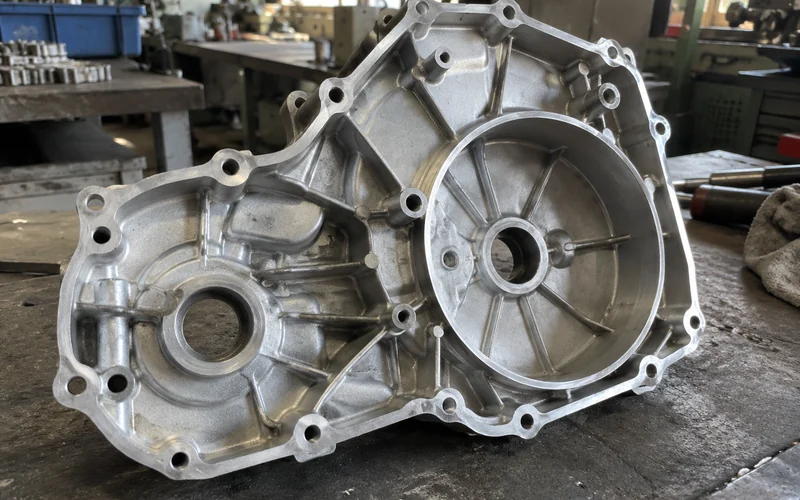
Appearance covers
Visible faces decide where gates, ejector marks and flash may sit. Mark every face that must stay clean.

Structural brackets
Loaded sections need sound metal where the load passes. Mark the load paths and the mounting faces.

Sealed housings
A sealing face cannot tolerate a pore exposed by machining. Mark the seal lands and any pressure test.
Mark every feature that cannot tolerate a gate witness, ejector mark, flash or exposed pore. We die-cast your part in our own factory, from die build to finished component.
Next: the alloy that suits that duty.
Choose the alloy with the process
Specify the casting alloy by grade, or by the properties the part needs, and approve the proposed grade. Alloy and process are checked together before any property is promised.
Aluminum or zinc
The two routes differ in part behavior and tool economics. Tell us which properties drive your choice.
Downstream effects
The alloy affects corrosion protection, machining, joining and any permitted thermal treatment.
Treatment and certificates
If you need a heat-treated condition or a certificate, say so at inquiry. Neither can be assumed from the words die casting.
Next: what the die costs and who owns it.
Weigh the die against your volume
A reusable die is a production asset. Compare its one-time design and build cost, sample correction terms, maintenance and ownership with the expected volume and the recurring part price.
Ask whether trimming tools, fixtures and spare inserts are included.
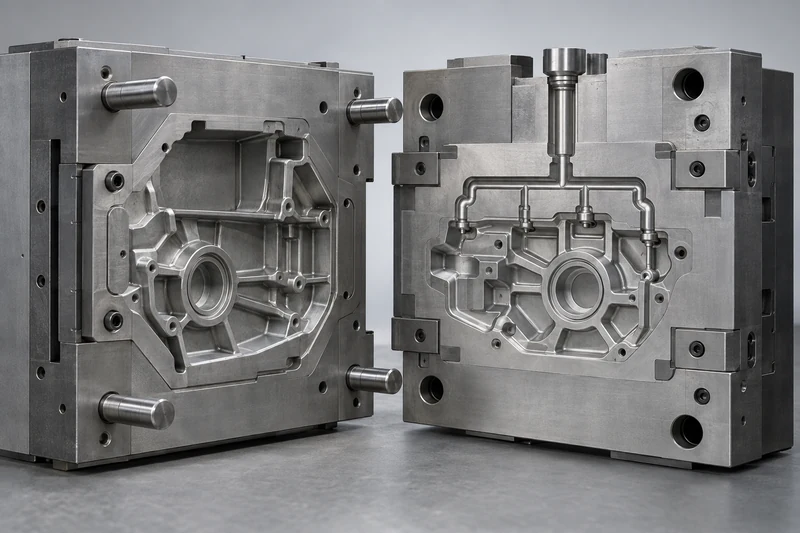

Compare against the part price
- Die design and build, as a one-time cost.
- Sample correction terms.
- Maintenance over the life of the die.
- Trimming tools, fixtures and spare inserts.
Name in the tool agreement
- Owner and custodian.
- Storage location.
- Maintenance responsibility.
- Transfer package.
- A condition and machine-compatibility review for any transferred die.
We design, build and hold the die, and your quote states the terms for ownership and transfer. If your volume will not carry a die, compare investment casting, sand casting or the full casting route overview.
Design the part for the die
Review wall transitions, ribs, bosses, draft, parting line, gate location and ejection before the die is released. A shape that looks feasible in CAD may trap air, create sink or move a cosmetic defect onto a visible face.
Identify where machining will create the final datums, and approve any proposed geometry change or tool mark against your function and appearance map.
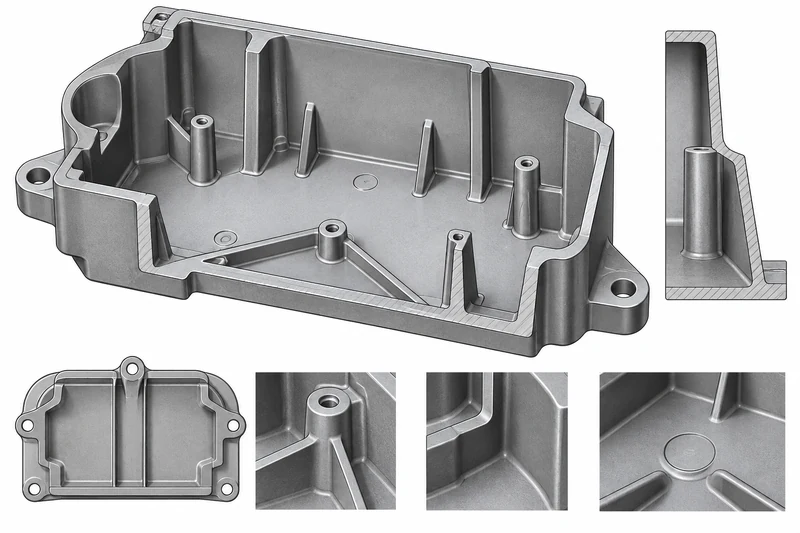
Wall transitions and ribs
Uneven sections can trap air or cause sink. Show the walls that seal, carry load or stay visible.
Bosses
A heavy boss can sink or hold porosity. Mark the bosses that are drilled, tapped or machined.
Draft and parting line
Draft and the parting line decide how the part leaves the die. Mark the faces where a parting line is not acceptable.
Gate location
The gate leaves a witness where metal enters. Agree its position before the first sample, not after.
Ejection
Ejector pins leave marks. Mark cosmetic, sealing, sliding and mating faces so the marks go elsewhere.
Mark where porosity matters
Porosity matters most where the part must seal, carry load or be machined into a pressure boundary. Mark those zones and state the allowed defect level and test method.
A general no-pores note is neither practical nor inspectable. Agree what happens if machining exposes a pore in a critical face: whether repair is allowed, how it is tested and how the rejected part is replaced.

| Zone | Why it matters | What to state |
|---|---|---|
| Sealing face | A pore can open a leak path | Allowed defect level and leak test |
| Load-carrying section | Pores reduce the sound section | Critical zone and inspection method |
| Machined pressure boundary | Machining can expose hidden pores | Machining depth and test after machining |
| Visible face | An exposed pore spoils the appearance | Cosmetic standard and reference sample |
Why it matters A pore can open a leak path
What to state Allowed defect level and leak test
Why it matters Pores reduce the sound section
What to state Critical zone and inspection method
Why it matters Machining can expose hidden pores
What to state Machining depth and test after machining
Why it matters An exposed pore spoils the appearance
What to state Cosmetic standard and reference sample
Porosity is a casting and a machining question at once. We do both in our own factory, so one team answers for a pore wherever it shows.
Have a sealing or pressure zone? Mark it before the die is designed.
Settle defect rules before the die is built
Moving a gate or changing a wall after the die is cut means rework and new samples. Send the drawing with cosmetic, sealing and machined zones marked, so the die layout, porosity limits and test method are reviewed together before production.
Production controls for repeat lots
Production controls cover alloy lot, die condition, process setup, trimming, first-article approval and repeat checks.
A die repair or process change can affect dimensions and porosity, so define the point at which a new sample is needed. Die casting runs in-house, and your quote lists the records that follow each lot.

Alloy lot
Identify each alloy lot so a later defect can be traced back.
Die and setup
Record the die revision and process setup that made the approved sample.
Trimming
Gates and flash are trimmed off. Agree how trim marks are accepted on visible faces.
First article and repeats
Approve a first article, then run repeat checks. A die repair calls for a new sample where features are affected.
Next: the machining and finish that complete the part.
From die-cast blank to finished part
Bores, threads, mounting faces and sealing lands may need CNC machining, and the surface treatment must suit your alloy and application.
Post-cast machining runs on our CNC machining line, a core HONGYI service. Each post-cast step for your part is listed in your quote.
Next: the checks that accept each lot.
Inspection planned around part risk
Plan the checks around what can go wrong with your part: alloy, dimensions, appearance, porosity in critical zones, pressure tightness where needed and finish.
Define sampling and report formats for the first article and for repeat lots, and ask for die-revision and lot traceability on repeat supply. The inspection records for your order are agreed with the quote.

| Check | What to define | Record to agree |
|---|---|---|
| Alloy | Grade and certificate format | Certificate per lot, if required |
| Dimensions | Critical features, datums and sampling | First-article and lot reports |
| Appearance | Cosmetic zones and reference sample | Approval against the sample |
| Porosity | Critical zones, method and acceptance limit | Result for each critical zone |
| Pressure tightness | Medium, pressure, hold time and allowed leakage | Test record, before or after machining as agreed |
| Finish | Treatment and acceptance standard | Finish check record |
What to define Grade and certificate format
Record to agree Certificate per lot, if required
What to define Critical features, datums and sampling
Record to agree First-article and lot reports
What to define Cosmetic zones and reference sample
Record to agree Approval against the sample
What to define Critical zones, method and acceptance limit
Record to agree Result for each critical zone
What to define Medium, pressure, hold time and allowed leakage
Record to agree Test record, before or after machining as agreed
What to define Treatment and acceptance standard
Record to agree Finish check record
What a die casting RFQ needs
A unit price without tool terms and defect responsibility is incomplete. Send what you have so the die, casting and finishing can be priced as separate lines.
Include in the first request
- CAD and the final drawing.
- Alloy and forecast volume.
- Cosmetic and sealing zones.
- Machined features.
- Desired tool ownership and inspection standards.
- Any existing die and its history.
- Whether finishing and leak testing are included.
Ask the quote to separate
- Die and trim tool cost.
- Sample cost.
- Casting price.
- Machining and finishing.
- Testing.
Parker reviews the drawing before any price is set.
Die casting FAQ
Short answers to the questions that usually come up before a die casting quote.
Is a die worthwhile when annual volume is low?
Compare tool investment and recurring part cost with demand and the alternatives. The answer depends on geometry, tool life assumptions and expected repeat orders, not a generic volume threshold.
How should die cost and piece price be separated?
List tool design, build, trials, maintenance and ownership separately from the casting and finishing price, and state any amortization assumption in the quote.
How do I raise porosity risk on a sealing face early?
Mark the sealing zone, pressure duty, machining depth and the required leak or internal-defect test. Agree acceptance and disposition before the die design is frozen.
Who is responsible if machining exposes a pore?
We are, because we cast and machine the part in our own factory. Agree the defect rule in advance, link the machined failure to the casting lot, and define whether the part is replaced, repaired or scrapped.
Can a die-cast part always be heat treated to a specified state?
No blanket assumption is safe. Alloy, process, porosity and target properties must be reviewed, and the exact treatment and validation specified.
Where should parting lines and ejector marks be avoided?
Mark cosmetic, sealing, sliding and mating faces on the drawing. Review the proposed tool layout and approve any marks before the die is cut.
What is needed to transfer an existing die?
Ownership proof, die drawings, component list, maintenance and repair history, latest part samples, process data and destination-machine details. Inspect its condition before accepting production risk.
What information is needed for an airtightness test?
Test medium, pressure, hold time, permitted leakage, test location, and whether the test comes before or after machining and finishing.
How are die repairs linked to repeat-order parts?
Record the die revision or repair, material lot, first part after the change and the related inspection. Reapprove the features the repair affects.
How does this page differ from Metal Casting?
Metal casting is the route-selection entry. This page covers the reusable die, volume economics, part design and porosity responsibility for a die-cast part.
Request a die casting quote
Send the CAD and tell us what the part must do. Parker reviews it and replies with questions or a proposal.

Parker
Your Die Casting Contact, HONGYI
I'm Parker. Send me the CAD, the alloy, your forecast volume, the critical cosmetic and sealing zones, the machined features and your die ownership requirement.
Ask me for a proposal covering the die, the casting, the machining and the inspection, all done in-house.
- Reply within 24 hours
- In-house production
- Drawings kept confidential