

China Metal Casting Service
Casting starts with what your finished part must do. Send the CAD, alloy, volume and machined areas, and get a review of the route, tooling and machining before you compare prices.
- Mark the critical machined areas and datums.
- State the end use and any defect or NDT requirement.
- Say whether you need an as-cast blank or a machined, inspected part.
- In-house production
- ISO 9001
- 24h quote response
- 80+ countries
What to settle before a casting quote
Jump to the route, tooling, production or inspection question you need to settle first.
Casting Parts
Define the part by its duty
Casting Process Choice
Investment, die or sand casting
Material Selection
Alloy grade, certificates and substitutes
Part Geometry
Walls, junctions, draft and cores
Tooling and Patterns
Cost, ownership and release gates
Casting Production
Melt, pour, clean and release
Machining Allowance
Stock on the faces you machine
Secondary Machining
Bores, faces, threads, final conformity
Inspection Plan
As-cast and finished acceptance
Quote Inputs
What to send for a firm quote
Casting FAQ
Ten questions buyers ask first
Request a Quote
Send your drawings to Parker
Casting parts start with their duty
Two castings with a similar outline can need very different soundness and machining. Define your part by its load, sealing, pressure and delivered state before you ask for a route.

Housings
A housing often combines sealing faces, bores and mounting holes. Mark the faces that must seal and the bores that locate internal parts.

Brackets and load parts
Load paths decide where the casting must be sound. Mark the loaded sections, the mounting faces and the holes that align with other parts.

Fluid components
Pressure boundaries and threaded ports set the soundness and test requirement. Mark the wetted passages, sealing threads and any pressure test.
State whether you need an as-cast blank or a machined, inspected component. We cast, machine and inspect in our own factory, so one supplier signs off the finished component.
Next: compare investment, die and sand casting for your part.
Match the casting route to your part
Investment, die and sand casting answer different geometry, tooling, volume and finish needs. No route is best by default; your part and forecast decide.
Weigh expected demand, part size, wall features, tolerances, surface quality and the cost of a pattern or die before you commit. Each route has its own page for the tooling and acceptance decisions that follow.

| Route | Typical decision driver | What your quote should cover |
|---|---|---|
| Investment casting | Intricate geometry and finish needs | Pattern tooling, shell, alloy and machining |
| Die casting | Repeat volume that pays for a dedicated die | Die ownership, casting machine and porosity limits |
| Sand casting | Part size, lower tooling commitment or internal passages | Pattern, cores, surface and machining allowance |
Typical decision driver Intricate geometry and finish needs
What your quote should cover Pattern tooling, shell, alloy and machining
Typical decision driver Repeat volume that pays for a dedicated die
What your quote should cover Die ownership, casting machine and porosity limits
Typical decision driver Part size, lower tooling commitment or internal passages
What your quote should cover Pattern, cores, surface and machining allowance
Vacuum casting for resin prototype copies is a separate process; see vacuum casting. For metal parts, your quote proposes the route, and we cast your part whichever route fits.
Not sure which route fits? Send the CAD and forecast and ask for a route comparison.
Specify the alloy, not just the metal
A bare label such as aluminum or steel rarely settles a quote when strength, corrosion, heat treatment or pressure integrity matters. Name a castable grade and the properties your part needs.
Grade and properties
Name the castable grade, or the properties that matter in use if the grade is open. Approve any proposed grade before tooling starts.
Certificates and traceability
Say whether you need a material certificate, a heat number or an approved substitute list for your order.
Substitutes and changes
A different alloy can change shrinkage, defect behavior and heat treatment. Agree any substitute before tool design or production is locked.
Check the alloy against the chosen route and against the final machining or finish. The geometry review below is where alloy, route and part shape meet.
Include the end use and any certificate you need.
Review castability before tooling
Wall transitions, junctions, draft and internal cavities decide where metal feeds and cools. Abrupt section changes and isolated thick masses raise defect risk.
Your finished CAD is not the as-cast shape. Tooling may add draft, radii, gates, risers or core features that never appear on the machined model, so approve those additions against your functional surfaces and cleanup areas.

Wall transitions
Abrupt changes between thin and thick sections raise defect risk. Mark the sections that carry load or seal.
Isolated thick masses
A heavy boss or junction can cool last and hold defects. Show whether that mass is functional or can be reduced.
Draft and radii
Tooling may need draft and radii that your machined model does not show. Say which faces must end up square after machining.
Gates, risers and cores
Feed and core features leave witness marks or cleanup areas. Mark the faces where such a mark is not acceptable.
Machining and inspection access
Faces that will be machined or measured must stay reachable. Identify them before the as-cast shape is fixed.
Price the tooling separately from the part
The pattern, mold, die or core package is its own cost and ownership question. A lower part price can carry a larger tooling commitment.
Ask for tooling and part price as separate lines, then set the gates that protect you from paying twice for a change.

Ask before you commit
- What the package includes: pattern, mold, die or cores.
- Who owns it, and the terms for storage and maintenance.
- Who pays for changes after release.
- Which files and physical tools transfer with the project.
Set the release gates
- A design freeze before the tool is released.
- First-sample approval before production.
- A review of rework, new trials and inspection for any revision after tool release.
We build and hold the tooling for your part, and your quote states the terms for ownership, changes and transfer.
Cast and machined under one roof
When a foundry and a machine shop quote separately, defects fall between them. We cast, machine and inspect your part in our own factory, so one team answers for it from pouring to final inspection. The next sections show what to agree at each step.
Every casting step in one factory
Melt, mold preparation, casting, cleanup, heat treatment and release to machining all run in-house, so no step waits on another company.
Agree how lots are identified and how a nonconforming casting is handled before machining adds cost.
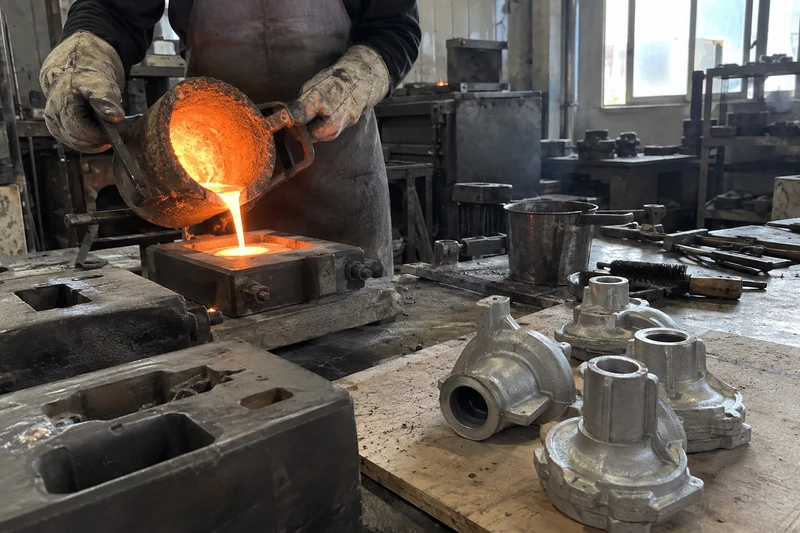
Mold and melt
We prepare the mold and melt the approved alloy for your part.
Pour and clean
The casting is poured, gates and risers are removed, and the part is cleaned before any machining.
Heat treatment
If your drawing specifies a treatment, agree whether it comes before or after machining.
Release to machining
Agree lot identity and how nonconforming castings are held before machining starts.
Next: the stock your machined faces need.
Machining stock on the faces that matter
Allowance must cover casting variation without adding needless material and machining time. Its value depends on the route, part size, geometry and how the casting is located.
No single allowance fits every part. Review the as-cast and finished models together.

Machined faces and datums
Mark every surface cut after casting and the final datums those cuts establish.
As-cast model approval
We propose the as-cast model from your finished drawing, and you approve it before tooling is built.
Undersized castings
A casting short of stock may fail only once machining starts. With casting and machining in one factory, it is traced to its cast lot and handled by one team, not argued between two suppliers.
Send the finished drawing with the datums marked.
Secondary machining and final conformity
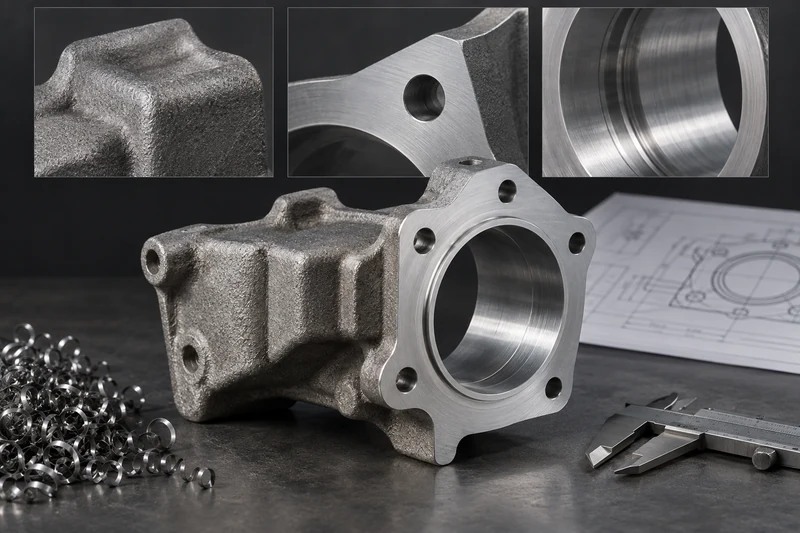
Bores, sealing faces, threads and locating surfaces often need machining after casting. We machine them in the same factory, so one team owns the conformity of the finished part.
Send the finished drawing with datums and critical tolerances, and we sign off the final part against it.
| Feature | Why it is machined | What to show |
|---|---|---|
| Bores | Fit and alignment with mating parts | Size, position and datum link |
| Sealing faces | Flatness and finish for the seal | Seal area, finish and flatness |
| Threads | Engagement and sealing | Thread standard and depth |
| Locating surfaces | Datums for assembly and inspection | Datum scheme and relationships |
Why it is machined Fit and alignment with mating parts
What to show Size, position and datum link
Why it is machined Flatness and finish for the seal
What to show Seal area, finish and flatness
Why it is machined Engagement and sealing
What to show Thread standard and depth
Why it is machined Datums for assembly and inspection
What to show Datum scheme and relationships
Post-cast machining runs on our CNC machining line, a core HONGYI service. Its fit for your cast alloy and geometry is settled in the project review, and as-cast and machined inspection stay separate checks.
Have a finished drawing with datums? Send it with the casting model.
Separate as-cast and finished acceptance
A casting passes two gates: as cast and as finished. Set the checks, methods and limits for each, and we report against both.
Nondestructive testing belongs in the scope only when your drawing, a standard or the part's risk calls for it. The inspection records for your order are agreed with the quote, including the rule for a defect that machining reveals.

Casting acceptance
Alloy identity, visible defects, internal soundness where specified, and heat treatment if required.
Finished-part report
Critical dimensions after machining, plus any leak or load test your drawing calls for.
Defect rule
How a defect exposed during machining is recorded, traced to the cast lot and resolved.
What a casting RFQ needs
A complete request lets the route, tooling and machining be assessed before pricing. Send what you have and mark what is still open.
Include in the first request
- Casting CAD or drawing, plus the final machined drawing.
- Alloy grade, or the properties the part needs.
- Quantity forecast and end use.
- Critical machined areas and datums.
- Defect standard, tests and required certificates.
- Any existing pattern or die information.
Ask the quote to separate
- Tooling cost and ownership.
- As-cast part price.
- Heat treatment, machining and testing.
- Shipping.
- The inspection record for each stage, agreed before order release.
Parker reviews the drawing before any price is set.
Metal casting FAQ
Short answers to the questions that usually come up before a casting quote.
Can I request a quote with CAD before choosing a casting route?
Yes. Send the material, volume, finished requirements and use conditions so the routes can be compared. The route is confirmed before tooling and acceptance are fixed.
Should the as-cast and machined drawings be separate?
They should at least distinguish the two conditions. A final drawing alone may not define draft, allowance or casting datums, and each state needs its own acceptance rules.
When is a precise alloy grade necessary?
When strength, heat treatment, corrosion, regulation or a mating process depends on it. Otherwise, describe the properties you need and approve the proposed grade.
Is pattern or die cost included in the unit price?
That is a commercial choice. Ask for tooling cost, ownership, maintenance and amortization as separate lines so you can compare offers.
Does every casting need nondestructive testing?
No. The drawing, the safety risk and the critical zones decide the method and frequency. If testing is required, state the standard and the acceptance limit.
Who is responsible for a defect exposed after machining?
We are, because we cast and machine the part in our own factory. The order defines replacement and inspection records, and the defect is documented against both the as-cast lot and the finished part.
How much machining allowance is enough?
It depends on geometry, casting route, size and how the casting is located. Review the as-cast and finished models together, because a generic allowance is unreliable.
Does the same company perform casting and machining?
Yes. We cast and machine your part in our own factory, and we are responsible for the accepted finished component.
Why might a small batch not suit die casting?
A dedicated die can be a large tooling investment. Weigh it against volume, geometry, other routes and expected repeats; die casting covers that decision in detail.
Is vacuum casting included in this metal casting scope?
No. Vacuum casting is a separate prototype-copy process, typically in resin. Its parts do not show metal casting capability or metal material behavior.
Request a metal casting quote
Send the drawings and tell us what the casting must do. Parker reviews them and replies with questions or a proposed route.

Parker
Your Metal Casting Contact, HONGYI
I'm Parker. Send me the casting and finished-part drawings, the alloy, the forecast quantity and the machined areas that matter. Add the end use and any defect or test requirement.
Ask me for the proposed casting route and a breakdown of tooling, casting, machining and inspection. Every step runs in-house, so one reply covers the whole part.
- Reply within 24 hours
- In-house production
- Drawings kept confidential