

Two CNC machining quotes can show different unit prices while covering different work. One supplier may include the specified material, finishing, and inspection report; another may assume an as-machined part without the requested inspection report. The difference becomes useful only when those assumptions are visible. CNC machining quote comparison identifies material, tolerances, inspection, finishing, lead time, and total scope as comparison points.
Send one controlled RFQ package to every supplier and request a base price for that package. Record proposed changes as separate options. This gives buyers a consistent reference when a bidder suggests another material, geometry, inspection plan, or manufacturing route.
Then align quantity, delivery, and commercial terms. The questions below move from technical scope to the pre-award decision, so a lower price can be traced to an explained process choice, an explicit exception, or an omitted requirement.
Are suppliers quoting the same manufacturing process?
Confirm that each base bid covers the same specified CNC machined part and delivered condition. Ask suppliers to name the machining route and included secondary operations. Require any proposed stamping, sheet metal, or molding alternative to carry its own scope, assumptions and separate price.
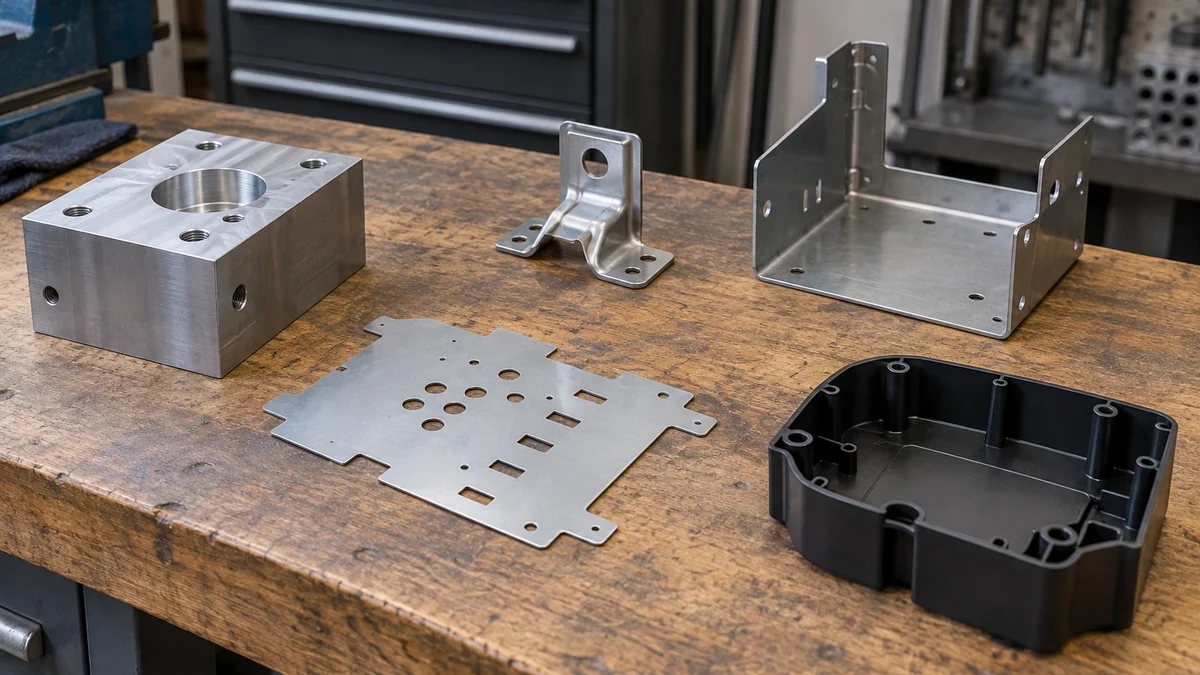
Ask each bidder to name the machining route covered by its base quotation and list the secondary operations included. Use a common bid sheet so every supplier responds to the same released configuration. Manufacturing complexity and total quote scope are comparison inputs in the quote comparison guidance.
| Comparison item | Information to record |
|---|---|
| Base configuration | Part number, active drawing revision and delivered condition. |
| Machining route | The bidder’s proposed operations and any stated exceptions. |
| Secondary work | Finishing, treatment and inspection included in the quoted route. |
| Proposed alternative | Separate material, geometry, tooling and acceptance assumptions. |
If a bidder proposes stamping, sheet metal fabrication or molding, keep that proposal separate from the base machining comparison. Ask which drawing requirements it retains and which it changes. This is a procurement recommendation for organizing bids, rather than a statement that every process can produce the same part.
Where an RFQ uses an ambiguous process label, obtain a written clarification before comparing prices. The supplier should identify the intended operations and the delivered configuration being priced. Share any accepted clarification with the other bidders and retain it with the released RFQ.
Compare the compliant base bids first. Review a permitted alternative against its own technical assumptions and acceptance requirements before making an award decision.
Did every supplier receive the same controlled files?
Send every bidder the same current 3D model and controlled 2D drawing, then obtain written confirmation of the part number, revision, units, and governing document. A quote based on an older model or an incomplete drawing package cannot be compared directly with one based on the released specification.

The model gives a bidder geometry to review and plan. The drawing carries controlled requirements such as tolerances, datums, threads, surface roughness, edge breaks, and notes. Neutral CAD files, drawing revisions, and specification details are identified as core inputs in RFQ guidance. Send the files together under one revision reference.
Check the package before requesting bids:
- The STEP or IGES model represents the intended part geometry.
- The 2D PDF drawing identifies the part number, active revision, units, and tolerance block.
- Critical features, GD&T, threads, roughness, edges, and notes appear on the controlled drawing where required.
- The RFQ states which document governs if model and drawing conflict.
- Each bidder confirms the files and revision received and lists unresolved interpretations.
Example: A bidder prices a model from an earlier revision while another uses the current drawing with a newly controlled hole location. Their prices describe different requirements even if both quotations name the same part. Resolve the mismatch and obtain a revised price for the released revision before ranking either offer.
Keep clarification responses with the RFQ record. If a technical correction changes the common requirement, distribute it to every active bidder. Require bidders to identify assumptions rather than silently fill gaps. A complete model and drawing package is also recommended by the CNC parts RFQ guide. The procurement check is straightforward: every bidder should acknowledge the same specification.
Are material and documentation assumptions identical?
Specify the exact material grade, temper or condition, product form, governing material requirement, and requested certificate before comparing bids. Check whether procurement and stock cutting are included. Treat substitutions and omitted documentation as explicit exceptions, because a broad material label does not establish the same delivered part.

A quotation for “aluminum” leaves more purchasing discretion than one for a specified alloy, temper, and stock form. The CNC machining RFQ guidance identifies exact material grade and temper as inputs that prevent conflicting assumptions. “6061-T6 aluminum bar” is an example of a defined request, not a material recommendation for every design.
| Requirement | Confirmation needed from each bidder |
|---|---|
| Grade and condition | Exact alloy or grade and required temper or other condition. |
| Product form | Whether the proposed bar, plate, or other stock matches the RFQ. |
| Governing requirement | The buyer’s material specification and its edition, where applicable. |
| Purchasing scope | Procurement, stock cutting, and any minimum purchase assumption. |
| Documentation | The certificate or traceability record expressly requested. |
Do not assume a certificate accompanies every order. State which document is required and how it must relate to the supplied material before bidders price sourcing and reporting. Material specification is a major quote input; setup and secondary operations can also affect price. How to write a CNC machining RFQ
If a bidder proposes another alloy, temper, source, or form, retain the specified material in the base bid and show the proposal as an alternative. Engineering can then assess the part’s mechanical, corrosion, finishing, and traceability requirements. A lower material charge becomes comparable only after the proposed change has been evaluated.
How has each supplier priced difficult geometry?
Ask each supplier to describe the setup, workholding, tool access, and inspection assumptions behind its base price for the released geometry. Deep cavities, thin walls, small holes, unusual threads, and features across several faces deserve explicit review. Price proposed design changes separately so the comparison still concerns the same part.

A complete drawing can still allow different machining plans. One shop may expect another setup; another may propose different workholding. Manufacturing complexity is a comparison factor, and setup is a recognized price driver. Quote comparison guidance, CNC RFQ guidance
Have bidders flag these features when they occur on the released part:
- Deep pockets that may call for longer tooling.
- Thin walls that may deform during machining.
- Small internal radii or critical threads that may change tool selection.
- Features on different faces that may require reorientation and reference checks.
- Features for which the bidder proposes additional inspection work.
Example: One quotation assumes a thin-walled pocket can be machined and inspected as drawn. A second bidder requests a thicker wall. That request may be useful design-for-manufacture feedback, but the revised geometry belongs in an option beside the price for the released design.
Request enough detail to explain a substantial price gap: proposed setup count, special fixture charges, features considered difficult, and inspection scope. The drawing should define the required result without prescribing a machine configuration simply to make bids appear uniform. If engineering accepts a geometry change, revise the controlled package and give every active bidder the same opportunity to price it.
Which tolerances are functional and priced as such?
Compare bids against the drawing’s actual general and feature-specific tolerances. Identify the fits, datums, positions, and geometric relationships that control function, then ask suppliers which requirements change machining or inspection effort. A quoted tolerance assumption should match the controlled drawing rather than a blanket interpretation of every model dimension.

A tolerance block sets a default only within its stated scope. Identify the separate limits on features that control fit, sealing, alignment, or assembly. Tolerances are major quote inputs, and their effect belongs in the price explanation. CNC machining RFQ guide, RFQ cost guidance
| Feature class | Controlled drawing requirement | Operation or verification to confirm |
|---|---|---|
| Ordinary geometry | Applicable general tolerance. | Routine machining and checking assumed in the bid. |
| Functional size or fit | Limits on the named bore, face, or mating feature. | Any added finishing or process control included. |
| Feature relationship | Datums and applicable GD&T controls. | Setup and inspection plan for that relationship. |
| Surface affected by treatment | Whether dimensions apply before or after finishing. | Final-condition verification included. |
Interpret the title-block default according to the controlled drawing’s stated scope. Do not copy another project’s tolerance onto this drawing. If a standard governs, identify its applicable edition and confirm how the drawing invokes it.
Ask bidders which explicit critical callouts and general tolerances they have priced. Have each bidder list tolerance exceptions and explain the proposed route for demanding features. Extra setups, slower cutting, temperature control, grinding, or broader inspection may be relevant, depending on the feature, material, and geometry. Assign that effort to the requirements that actually need it.
Does each price include the specified finished condition?
Check each bid against the required condition of every relevant surface and edge, including roughness, deburring, treatment, masking, marking, and cosmetic acceptance. Ask whether secondary work, outside processing, and final inspection are included. If required finishing or inspection is omitted from an as-machined quotation, request a revised bid before comparing it with a quote for the finished and verified part.

Surface requirements should identify where they apply. Locate each required roughness callout on the controlled drawing and compare the affected surfaces in every bid. Record the parameter, value and unit actually specified for the part. If a supplier labels a surface “as machined,” ask it to confirm whether the drawing’s roughness callout is included in that quoted condition. The quotation should state which secondary operations are included. RFQ guidance for CNC machined parts
| Finished-condition item | Specification and quote check |
|---|---|
| Roughness | Parameter, value, unit, affected surface, and required reading. |
| Edges | Deburring or specified edge condition, including exceptions. |
| Treatment | Applicable heat treatment, anodizing, plating, coating, or passivation. |
| Protected zones | Surfaces requiring masking or exclusion from treatment. |
| Appearance and marking | Cosmetic zones and any required mark location or condition. |
| Final verification | Dimensions or surface results checked after treatment. |
Example: One bidder quotes an as-machined housing while another includes anodizing and masking on a fitted interface. Their unit prices cover different delivered conditions. Mark the treatment and protected interface on the drawing, then obtain a price for the complete route from the first bidder.
Secondary operations are among the main RFQ inputs identified in machining RFQ guidance. Ask each bidder who performs the secondary work and whether its quotation includes that work and any required final inspection. Where a treatment can affect a fitted feature, clarify whether its dimension applies before or after treatment. Identify the affected surfaces and required final checks explicitly in the RFQ.
Is inspection scope the same in every bid?
Define the characteristics to be inspected, the extent of inspection, any necessary measurement method, and the records due with the parts. Confirm that every quote includes the same inspection setup and reporting work. A certificate, a dimensional result, and a special-process record answer different acceptance questions.

Inspection affects a CNC quotation, so its scope belongs in the common RFQ package. How to write an RFQ for CNC machined parts identifies inspection as a quote input. Critical limits on a drawing do not, by themselves, tell bidders which results must be recorded and supplied at delivery.
Tie the inspection request to the drawing:
- Name the critical dimensions, datums, geometric controls, and roughness zones requiring documented results.
- State whether results cover a first article, the full drawing, selected features, production samples, or another defined extent.
- Define any mandatory measurement method on the drawing or RFQ, including CMM measurement when a specified feature relationship requires it; otherwise require each bidder to state its proposed method.
- List the requested certificate of conformance, material certificate, and records for specified secondary operations separately.
- Confirm reporting format, delivery timing, and whether inspection setup and labor are included.
A declaration of conformance is different from measured dimensional results, and material documentation does not establish finished dimensions. Establish what each bidder will deliver instead of accepting “inspection included” as a complete answer. The CNC parts RFQ guide likewise includes inspection requirements in the quotation package.
For a difficult feature relationship, agree on the datum basis and measurement condition before bids are final. If one bidder includes structured verification and another assumes routine checks without a report, record the difference as an exception or obtain a revised quote. The acceptance package should be the same one the buyer will require with the parts.
Were unit prices calculated for the same quantities?
Give every supplier the same immediate quantity, batch size, expected repeat demand, and requested price tiers. Compare recurring piece prices separately from programming, setup, fixtures, inspection setup, and first-article charges. A unit price based on another lot size or a different treatment of one-time costs does not answer the same purchasing question.

Quantity affects how programming and setup effort is assigned to an order. The RFQ sources identify quantity tiers and setup as inputs to machining price. CNC parts RFQ guide, RFQ cost guidance Give bidders one quantity schedule instead of comparing the most attractive tier from each quotation.
| Comparison field | Basis to state in the RFQ and confirm in the bid |
|---|---|
| Immediate order | Quantity being considered for award. |
| Price tiers | The same quantities, such as 1, 5, 25, and 100 pieces when relevant. |
| Batch and lot pattern | One production and delivery lot or defined split lots. |
| Repeat demand | Annual usage assumption, if known, and design stability. |
| One-time charges | Programming, fixtures, setup, inspection setup, and first-article work. |
| Recurring charge | Piece price at each agreed quantity. |
Confirm whether fixtures and setup are charged separately or distributed across the piece price. A price that spreads a fixture charge across 100 parts is not directly comparable with one that charges the fixture separately for a five-part prototype. Obtain totals for the same intended order before ranking the offers.
A price tier may also assume future releases rather than a firm immediate order. If the work is a prototype, say so: production intent can change setup and inspection assumptions. Keep future price breaks visible, but compare the amount payable now. A lower unit price at a larger quantity does not by itself establish a better purchase when the design may change.
Does quoted lead time cover arrival in the same place?
Define when each supplier’s schedule starts, what work it includes, and whether its date means shipment or arrival. Give every bidder the same destination and freight basis. Compare the route through material sourcing, machining, outside processing, inspection, packing, and transit before treating two lead-time figures as equivalent.

A single lead-time figure conceals its starting point and included work. Quote comparison guidance identifies lead time alongside finishing, inspection, and total scope as matters to reconcile. How to compare CNC machining quotes Establish whether the schedule starts at purchase-order receipt, technical approval, material availability, or another agreed event.
Trace the proposed route through material procurement, engineering review, programming, fixture and setup preparation, machining, outside processing, inspection, documentation, packing, and transit. This shows whether a quoted date includes finished-part inspection or only completion of cutting. It also exposes steps that depend on an outside provider, an unresolved specification, or a material purchasing assumption. A finish or certificate added after award may change the route on which the date was based.
Use one delivery endpoint for every bidder. State the destination and whether the required date means shipment or arrival. If an Incoterm or freight basis applies, specify it in the RFQ and have each bidder identify what its schedule and price include. Request separate factory-completion, shipment, and arrival milestones where they matter to the order.
Record an expedited route as a separately priced option with its included operations. Compare base dates only after the schedule start, processing scope, inspection release, packing, transit, and delivery endpoint have been aligned.
Can the total delivered cost be reconciled?
Compare the amount payable for the same finished, inspected part at the same quantity and delivery basis. Request enough cost detail to explain differences in material, setup, machining, secondary work, documentation, and freight. Record quote validity and change terms so a low unit price is assessed within its actual commercial scope.

A breakdown helps reconcile scope without requiring bidders to use the same internal costing method. Material, quantity, setup, inspection, and finishing are identified RFQ price factors. How to write an RFQ for CNC machined parts Confirm the included delivered work first, then determine what explains a material price difference.
| Cost or term | Check before award |
|---|---|
| Material and stock cutting | Specified grade, condition, form, and purchasing assumption. |
| Programming, fixtures, and setup | Separate one-time charge or amount included in unit price. |
| Machining and deburring | Work required by the released geometry and edge specification. |
| Inspection and documents | Measurement, reporting, and requested certificates. |
| Secondary operations | Specified heat treatment, finishing, masking, and outside work. |
| Delivery charges | Packaging, freight, applicable taxes or duties, and any expedite charge. |
| Commercial terms | Quote validity, minimum order quantity, tooling ownership, and treatment of changes or rejected parts. |
The quote comparison guidance calls for reviewing total scope and quote validity alongside price. An omitted operation can explain a low quote without establishing anything about machining capability. Request a corrected base price or a separately priced exception rather than estimating the missing work yourself.
Calculate the total for the actual order quantity and agreed delivery basis. Keep future price breaks visible, but do not substitute them for the present purchase cost. If an engineering change or new drawing revision is possible, record how each bidder would treat it; the original price applies to its stated scope.
What exceptions must be resolved before ranking bids?
Use one comparison sheet against the controlled RFQ and require each bidder to mark requirements as included, excluded, or assumed. Resolve material, geometry, tolerance, finish, inspection, quantity, schedule, and commercial exceptions before ranking total delivered cost and technical compliance. An unexplained low price is a clarification task, not an award decision.

The final comparison should use the same specification sent for quotation. Consistent review of material, tolerances, inspection, finish, lead time, and total scope is described in CNC quote comparison guidance. A proposed alternative may be useful, but its technical differences and price need separate identification.
Use this pre-award approval checklist:
- Confirm the named manufacturing process and active model and drawing revision.
- Mark material grade, condition, form, standard, and required certificate as included, excluded, or assumed.
- Check whether the base price covers released geometry, critical tolerances, finish, and edge requirements.
- Match inspection characteristics, extent, method where required, and delivery records.
- Align immediate quantity, price tiers, batch or lot pattern, and one-time charges.
- Align schedule start, ship or arrival milestone, destination, freight basis, and complete delivered cost.
- Record tooling ownership, quote validity, minimum order terms, and treatment of revisions or rejected parts.
- Obtain written clarification or a separately priced option for every unresolved exception.
An unanswered assumption is not a confirmed inclusion. If a bidder cannot price a released requirement, show the exception and its effect on the offer. If engineering accepts an alternative in principle, approve the technical change before comparing its price with another bidder’s base offer.
The award record should identify the selected quotation revision and its incorporated clarifications. Rank each bidder on the finished part, quantity, inspection package, delivery commitment, and total cost it has actually agreed to provide. A low price alone establishes neither poor capability nor equivalent scope.
For a comparable quotation, send the current 3D model and controlled 2D drawing, material grade and condition, quantity, prototype or production intent, critical tolerances, surface finish, inspection expectations, revision level, and delivery requirements. Require each bidder to acknowledge the package, identify exceptions, and price proposed alternatives separately.