
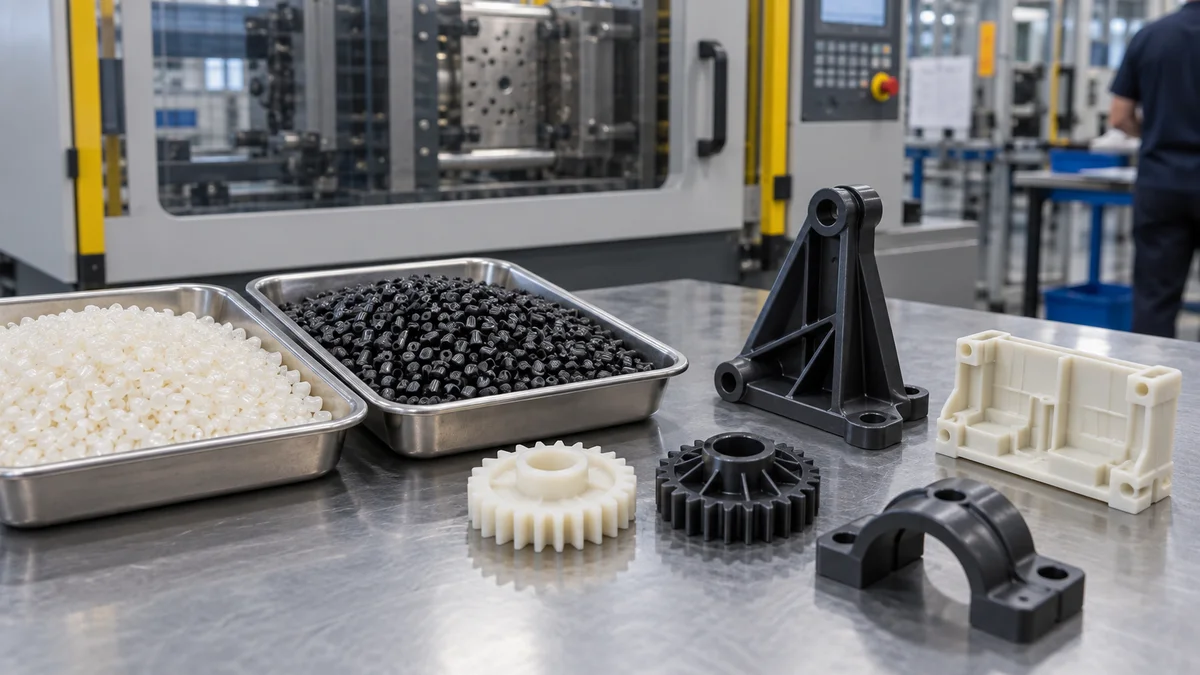
A nylon part may need enough flexibility for repeated movement or enough stiffness to hold its shape under load. The base resin, glass content, gate position, wall geometry, moisture state, and acceptance conditions all affect that choice.
Compare proposed grades against the same drawing and service requirements. A published material comparison cannot establish how a particular molded feature will perform or measure after conditioning.
The material decision starts with the grade and load case, then moves through filling, dimensional acceptance, appearance, and tooling. A complete RFQ gives molders a common basis for quotation and sample approval.
Which nylon grade is actually being specified?
Specify the base resin, exact commercial grade, and whether the nylon is unfilled or glass-filled. If it is glass-filled, state the reinforcement level. PA6 and PA66 are not interchangeable specifications; a drawing that says only “nylon” leaves material, molding, and acceptance assumptions open.

The material callout should distinguish PA6 from PA66 and identify glass content where applicable. Reinforcement level affects the dimensional and mechanical behavior the molder must evaluate; it cannot be inferred from the word “nylon.” The glass-filled nylon grade comparison discusses reinforcement alongside shrinkage, moisture absorption, and fiber orientation. Request information for the exact proposed grade when comparing alternatives.
This article concerns plastic injection molding: nylon compound enters a mold, and the finished geometry depends partly on filling and shrinkage. The nylon processing guide connects the filling pattern with fiber orientation, shrinkage, and part performance. Record the grade, color, and permitted alternatives on the controlled drawing or RFQ. A proposed substitution should return for engineering review against the same load, geometry, appearance, and inspection conditions.
Keep the RFQ specific to injection molding for this nylon part. If the drawing or purchasing record uses a different process name, confirm the intended manufacturing route before comparing quotations.
Does the part need stiffness or controlled flexibility?
Choose the grade to investigate from the part’s load and movement requirements. Unfilled nylon may suit features that need ductility and controlled flexibility; glass-filled nylon warrants review when stiffness or creep resistance under sustained load matters. Check the exact grade, fiber direction, weld lines, temperature, moisture state, and expected cycles.
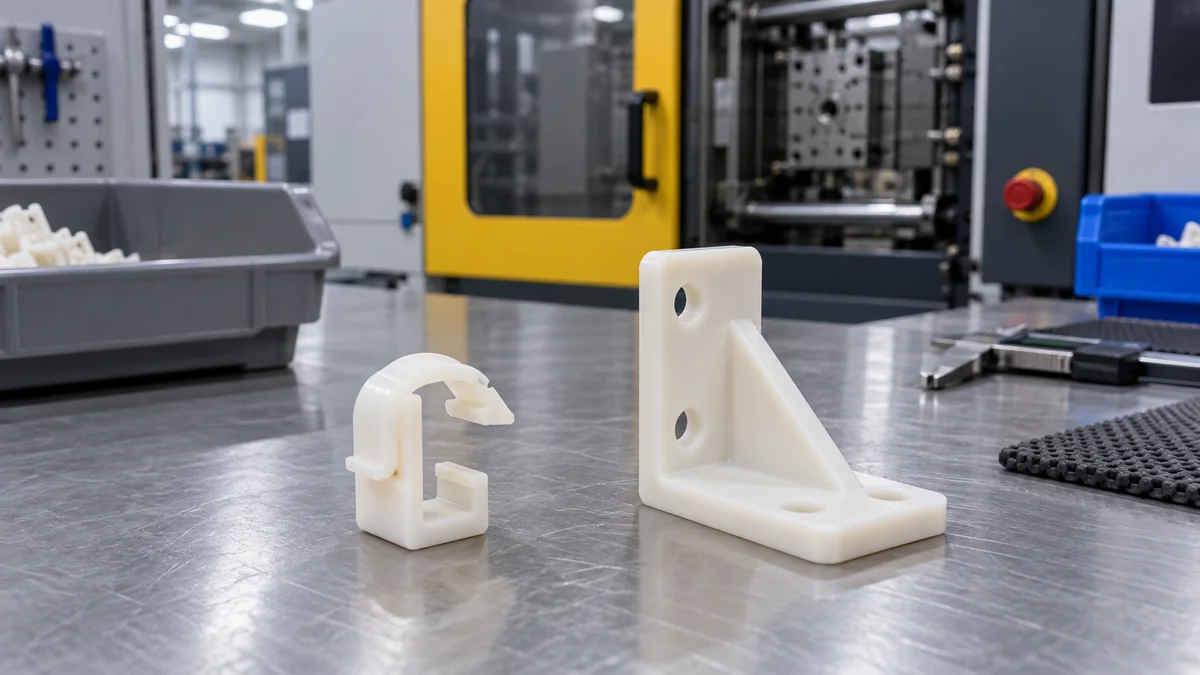
State the load direction, permitted deflection, impact exposure, operating temperature, and expected cycles before comparing grades. The glass-filled nylon grade comparison discusses reinforcement and direction-dependent behavior, while the nylon processing guide connects fiber orientation with molded performance. Reinforcement can increase stiffness while reducing ductility; request grade-specific tensile-modulus and other relevant property data, then review molded-part evidence before accepting a flexing feature. A published comparison alone is not a design value for the proposed grade.
| Feature requirement | Unfilled candidate: specify or verify | Glass-filled candidate: specify or verify |
|---|---|---|
| Repeated snap movement | Required deflection, impact exposure, and cycles | Whether reduced ductility suits the movement |
| Deflection under sustained load | Allowable deflection and grade-specific tensile-modulus data for the service condition | Grade-specific tensile-modulus data, reinforcement level, and load direction |
| Loaded feature crossed by a weld line | Weld-line location in sample review | Weld line relative to fiber direction and load path |
Example: A snap feature and a load-bearing bracket need different evidence even if both are drawn in nylon. Define movement and cycles for the snap; define load direction and allowable deflection for the bracket. This comparison does not establish that either grade will pass. Ask the material supplier and molder to assess representative molded geometry under the specified temperature and moisture conditions.
How will gate placement direct the fibers and shrinkage?
Review the proposed gate against both the primary load path and critical dimensions. In glass-filled nylon, filling direction influences fiber orientation, directional properties, and shrinkage. Mark gate restrictions, weld-line concerns, and acceptance-critical features before the layout is fixed; use shrinkage data for the selected grade.

Gate location changes the melt-flow pattern through the mold. For glass-filled nylon, that route influences fiber alignment, which can change properties along the load path and the relative shrinkage along and across the flow path. The nylon processing guide connects filling with orientation and performance; the glass-filled nylon molding guide discusses anisotropic shrinkage and warpage.
Published guidance describes direction-dependent shrinkage in glass-filled nylon. The glass-filled nylon processing guide explains how fiber orientation and gate placement can affect dimensional behavior. A single shrinkage allowance should not be transferred across directions or into an untested compound and geometry. Obtain the resin supplier’s grade-specific data and have the toolmaker evaluate it against the gate, wall distribution, and proposed process conditions.
On the drawing, distinguish critical spans likely to run with flow from those across it. Identify loaded features, important hole relationships, permitted gate witnesses, and surfaces where a weld line needs review. If the gate moves to protect a cosmetic face, revisit the resulting load path and dimensional risks. Sample inspection should measure the controlled features in their specified orientation and conditioning state, allowing the buyer to judge the proposed gate layout against assembly requirements.
Can the geometry resist glass-filled nylon warpage?
Check wall distribution, ribs, broad panels, and filling balance before treating glass reinforcement as a dimensional fix. Directional shrinkage can still make a part bow or twist. Define the flatness, hole-position, and assembly relationships that matter, then assess the proposed geometry and gate plan before approving tooling.

Lower shrinkage in one direction does not establish that an entire molded part will remain flat. The nylon molding processing guide links melt-flow pattern, fiber orientation, and directional shrinkage. The glass-filled nylon warpage guidance describes anisotropic shrinkage where fiber alignment, flow direction, and cooling interact. The glass-filled molding guide also identifies anisotropy and warpage as design concerns.
Scenario: Consider a broad panel with a long reinforcing rib. If the proposed gate drives flow mainly along the rib, the supplier should examine how shrinkage along and across that path affects the panel and its assembly holes. This is a design-review scenario, not a recorded project result. Review wall uniformity, rib proportions, and filling balance in the actual CAD model. Multiple or repositioned gates may merit evaluation for some geometries, subject to weld-line, appearance, and dimensional requirements.
For a large or tolerance-critical part, ask whether mold-flow analysis would help compare layouts before mold construction. Its resin data, gate assumptions, and wall geometry must represent the proposal being evaluated. Analysis remains a review input; approval still needs samples made under the agreed conditions. Put functional flatness limits, critical hole positions, and mating surfaces on the controlled drawing. Define the datums and measurement condition so sample inspection checks the assembly relationship rather than relying on a visual impression of flatness.
What moisture control is required during molding?
Require drying and storage controls for the exact nylon grade before molding approval samples or production parts. Both unfilled and glass-filled nylon absorb moisture, but a published moisture threshold is not a universal process setting. Ask the molder to identify resin lots and connect available handling records to the samples.

Moisture control belongs in the proposed molding route. The glass-filled nylon molding guide calls for drying glass-filled nylon below 0.2% moisture before molding. The process-control guidance also treats moisture and mold conditions as connected variables. Some glass-filled guidance specifies below 0.1%. Neither threshold should be copied across grades without checking the resin supplier’s instructions, packaging history, and proposed process.
Ask the molder to identify the controls used for samples and repeat production:
- Exact resin grade, color, reinforcement level, and lot.
- Grade-specific drying procedure and sealed-storage practice after drying.
- Available dryer or moisture-control records linked to the molded samples.
- Any proposed regrind use or restriction requiring approval.
These requests define the evidence needed for approval rather than prescribing an unverified drying time or temperature. If the supplier proposes another grade, review its handling instructions separately. Link the material lot and conditioning records to the parts being measured so approval applies to a known molding condition. Keep resin drying before molding distinct from the finished part’s moisture state for dimensional acceptance. A recorded drying procedure does not, by itself, establish how a part will measure after service exposure.
In what moisture state must critical dimensions pass?
State when and in what moisture condition the finished part must meet its critical dimensions. Glass reinforcement may reduce moisture-related movement, but it does not remove the need for a defined acceptance state. Identify functional fits and agree on conditioning, measurement environment, and inspection timing before samples arrive.

A dimensional report needs a defined part condition. The glass-filled nylon grade comparison addresses how reinforcement and moisture absorption relate to dimensional behavior. A family-level comparison cannot predict movement of an individual molded fit. Request grade-specific supplier data for the selected resin and part condition. State service humidity and the chosen conditioning procedure where they affect assembly.
Example: A mating hole could be checked soon after molding or after a specified conditioning step. Those are different acceptance states. Identify which state the drawing limits govern, then request measurements in that state. The example assumes no particular amount of hole movement; it shows why buyer and supplier can disagree about fit when inspection conditions differ.
Mark fitted holes, mating faces, alignment patterns, and overall dimensions that control assembly. Give critical features their required tolerances and datum relationships on the controlled drawing. Specify whether acceptance applies dry, as-molded, or after defined conditioning, together with inspection timing and measurement environment. If the part must work across more than one moisture condition, define the relevant functional checks. Passing one dry-state measurement cannot automatically establish service fit. Sample approval should identify both the exact grade and the condition of the parts inspected.
Which surfaces have appearance requirements?
Mark visible surfaces and their acceptance requirements separately from functional dimensions. Unfilled and glass-filled grades may produce different molded appearances, so review samples made with the proposed grade and conditions. Define texture, gloss variation, weld-line location, and gate vestige only where those characteristics affect appearance.

A material chosen for load or dimensional reasons may change the appearance of a visible face. Glass-filled nylon can show exposed fibers or a rougher surface under some molding conditions. The glass-filled nylon processing guidance discusses fiber bloom with gate placement and process control. Use those concerns to identify faces needing sample review.
Separate requirements on the drawing or cosmetic specification:
- Identify visible faces and hidden or less critical zones.
- State the intended texture or gloss expectation and any comparison sample.
- Mark permitted gate-witness and weld-line areas.
- Keep mating dimensions, flatness, and other functional limits in the dimensional acceptance plan.
“Smooth” alone gives the molder little basis for deciding whether a visible surface effect is acceptable. Define the location and viewing condition used for sample approval. If an alternative resin is proposed, review its appearance under the proposed molding conditions before accepting it as cosmetically equivalent. Appearance approval does not replace dimensional or load verification, and passing dimensional inspection does not establish that a visible surface meets the agreed cosmetic requirement.
What tooling and process work changes the quote?
Compare the complete molding program for each candidate grade. Glass-filled nylon calls for review of gate and runner design, venting, wear exposure, maintenance, inspection, and resin handling. Ask each molder to state its tool construction, process assumptions, and any regrind restriction alongside the molded-part price.
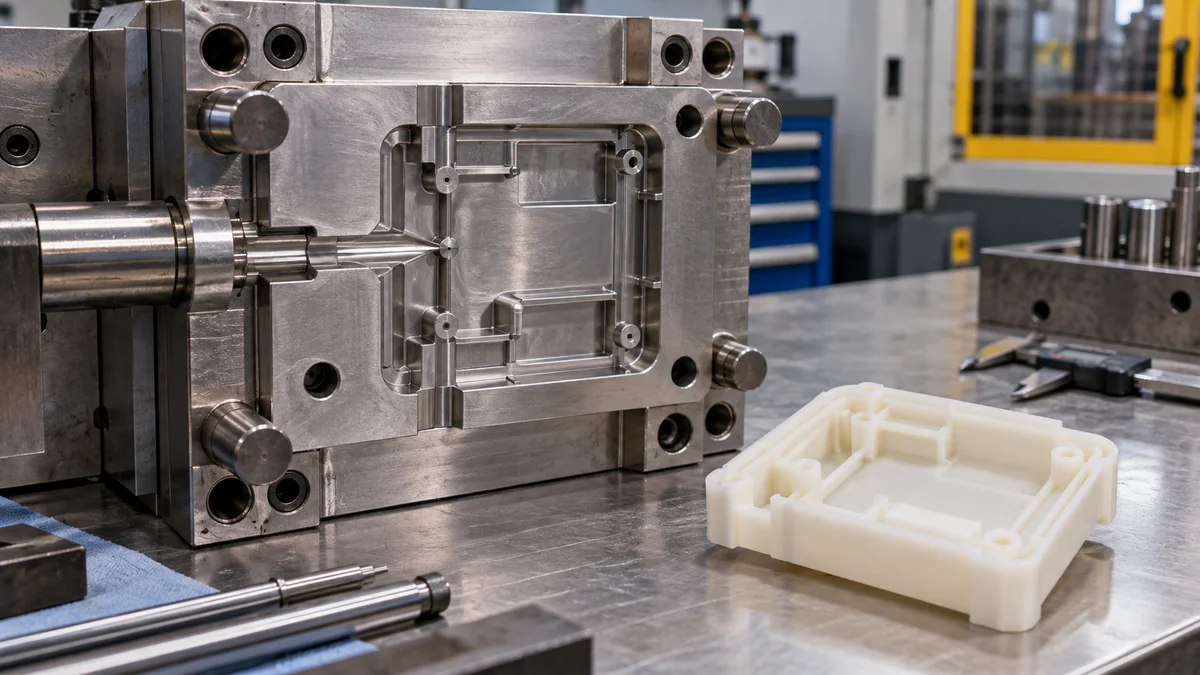
A molded-part price alone does not show whether suppliers included the same tooling and validation work. Glass fibers are abrasive and can increase wear at the gate and other mold regions. The glass-filled nylon processing guidance addresses mold temperature, gate placement, fiber orientation, and moisture control. The nylon processing guide connects gate and flow decisions with part behavior. Request a described molding plan for the exact proposed grade.
Ask where flow and wear require attention, including gates and other selected mold regions. Have the supplier identify proposed core, cavity, or insert materials and the maintenance points allowed for. Hardened tool steel or inserts may merit review in wear-critical areas. Review gate and runner design, venting, and regrind restrictions as choices for the filled compound; do not assume every grade needs the same tool layout. Ask how the proposed route supports critical dimensions and visible surfaces.
Compare quotes using the same quantity, expected repeat demand, active revision, inspection scope, and delivery requirement. Request separate assumptions for tooling, sample approval, process development, maintenance, and recurring parts. If an alternative grade changes the gate strategy or acceptance testing, ask the supplier to show the change. This gives procurement a comparison of the delivered, approved part rather than resin price alone.
What must the material-selection RFQ contain?
Send the current model and controlled drawing, the exact proposed nylon grade, and the conditions the molded part must meet. Include load, geometry, cosmetics, critical dimensions, conditioning, inspection, quantity, production intent, and delivery needs. Require engineering approval and comparative validation before a supplier substitutes the resin or reinforcement level.

An RFQ should let each molder evaluate the same part, material decision, and acceptance state. The nylon processing guide links gate location and flow with fiber orientation and final behavior. The glass-filled nylon guide identifies directional shrinkage, warpage, and drying as review areas. Supply enough geometry and service information for the proposed route to address those issues.
RFQ and sample-approval checklist
- Current 3D model, controlled 2D drawing, active revision, and governing document if they differ.
- Exact preferred PA6 or PA66 grade, glass content, color, and explicitly permitted alternatives.
- Immediate quantity, expected repeat demand, prototype or production intent, and delivery expectations.
- Load direction, allowable deflection, impact, temperature, humidity, intended cycles, and mating materials.
- Wall and rib geometry, critical dimensions and datums, cosmetic zones, surface-finish expectations, and gate restrictions.
- Required conditioning state, inspection timing, measurement condition, reporting scope, and sample-approval checks.
Identify fixed requirements and items open to the molder’s recommendation. “Equivalent nylon” should not bypass review of reinforcement, fiber direction, moisture behavior, appearance, or critical fits. If a supplier proposes a substitution, request engineering approval and comparative validation against the same drawing and operating conditions. The quotation should identify the grade and material-handling assumptions used for tooling, samples, and production parts.
For a material recommendation or comparable injection molding quotation, send the current 3D model and controlled 2D drawing with its revision level. Include the proposed nylon grade and glass content, quantity, prototype or production intent, load and moisture conditions, critical tolerances, surface finish and cosmetic zones, inspection expectations, and delivery requirements. Ask the molder to identify the gate, conditioning, tooling, and sample-approval assumptions behind its proposal.