
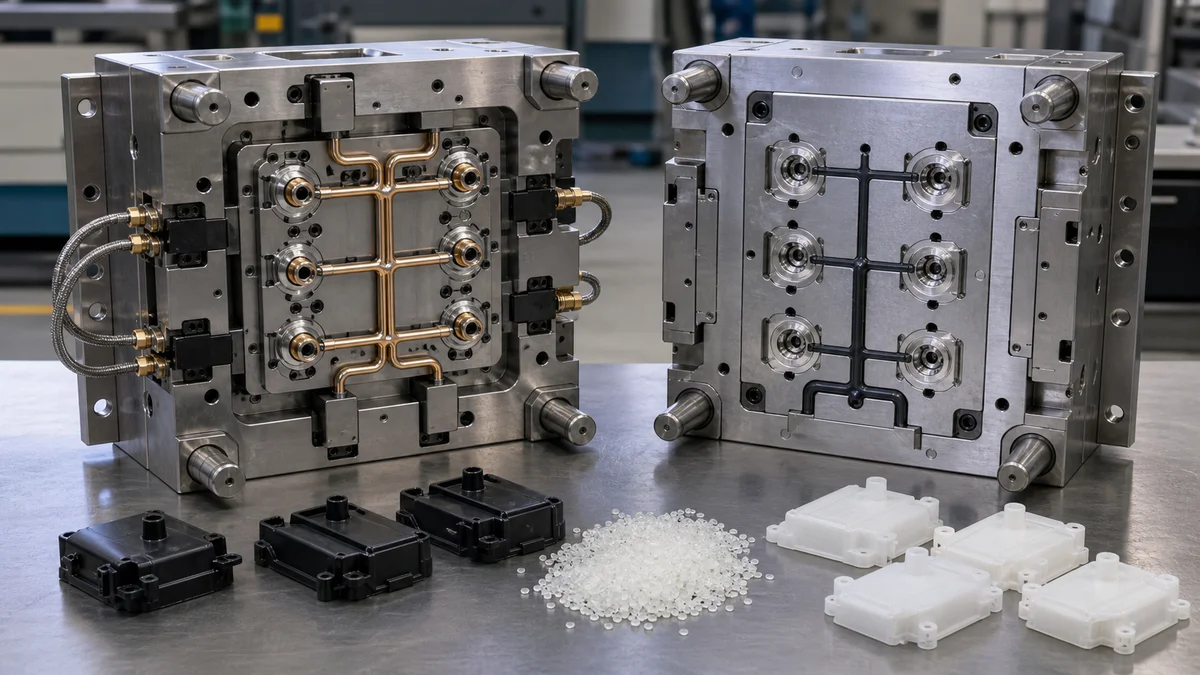
Choosing between a hot runner and a cold runner involves more than balancing material waste against mold cost. The correct system depends on the specified resin’s thermal behavior, available gate locations, cavity layout, regrind policy, cosmetic requirements, and the stability of the design and production forecast.
The runner system also influences degating, dimensional consistency, maintenance, changeovers, inspection, and recurring production cost. The comparison should therefore begin with the plastic part’s functional and commercial requirements, not with a preferred mold configuration.
A useful decision separates the runner operating principle from the resin, geometry, tolerance, cost, and production risks that determine whether it fits the program.
How Do Hot Runner and Cold Runner Molds Work?
A hot runner keeps resin molten through heated manifolds and nozzles until it enters each cavity. A cold runner allows resin in unheated feed channels to solidify with the part, after which the runner is ejected and separated before another molding cycle begins.
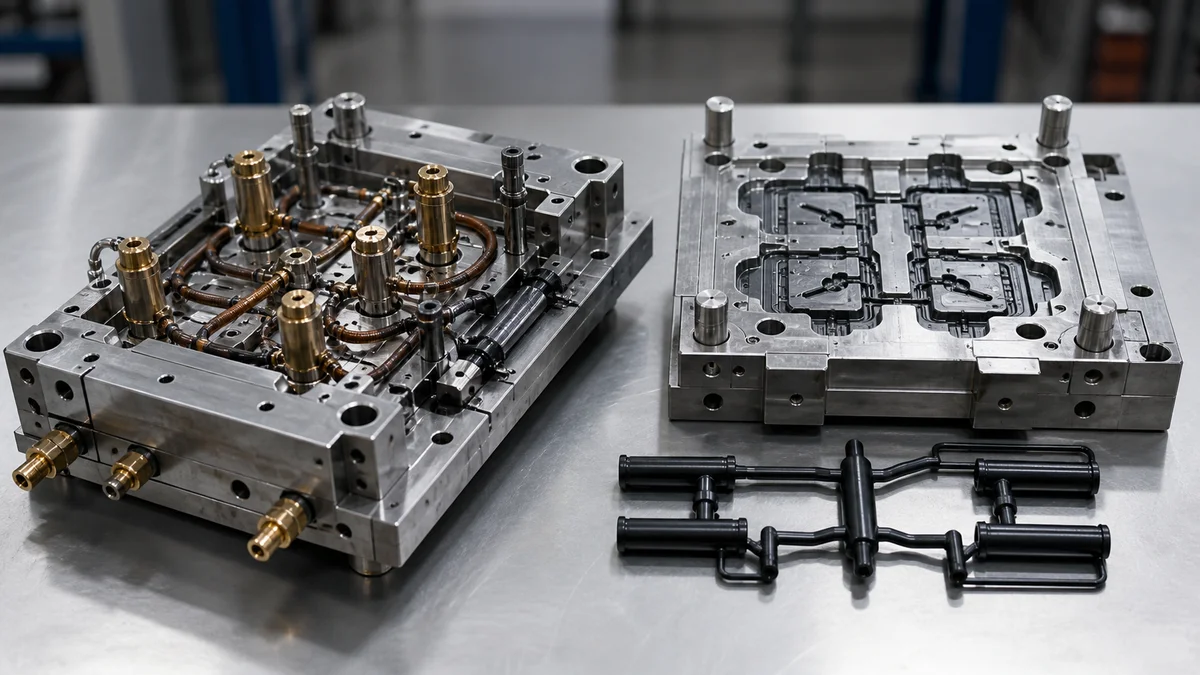
Both are feed systems used in plastic injection molding1. Molten polymer passes from the molding machine through the runner, crosses the gate, fills the cavity, cools, and is ejected as a formed part. The distinguishing question is whether the resin between the machine nozzle and cavity stays molten or becomes part of the cooled shot.
| Specification point | Hot runner | Cold runner | Practical consequence |
|---|---|---|---|
| Runner temperature | Heated passages keep resin molten | Unheated passages allow resin to solidify | Changes thermal control and ejection planning |
| Ejected material | Normally the molded parts without a solid runner network | Parts and a solid runner network | Determines separation and material-handling needs |
| Gate separation | Gate design may reduce separate degating | Runner must be separated from the part | Can affect labor, gate witness, and nearby edges |
| Material disposition | Retained resin requires temperature and changeover control | Runner is discarded or reground when permitted | Requires different material-control policies |
| Mold construction | Includes manifolds, nozzles, heaters, and controls | Uses a simpler feed-channel arrangement | Changes tooling, maintenance, and validation scope |
The operating principle affects mold design, cycle planning, resin utilization, changeovers, and maintenance. It does not establish part quality on its own. Wall thickness, gate location, packing, cooling, resin condition, cavity balance, draft, and ejection still govern how the molded part forms and releases.
Process terminology should also be exact. CNC machining removes material from solid stock. CNC turret punching2 and CNC punch presses use programmed punch tools on sheet metal. Metal stamping cuts or forms sheet with dedicated dies. Sheet metal fabrication may combine cutting, punching, bending, welding, and finishing. These processes are distinct from plastic injection molding. “CNC turret punching, CNC punch press, CNC-controlled stamping equipment, or metal stamping depending on the actual process” is not one standard process term; an RFQ using it should clarify whether it means CNC turret punching, CNC-controlled stamping equipment, or general metal stamping.
Which Runner System Fits the Specified Resin?
Choose the runner system after confirming the exact resin grade, additives, thermal sensitivity, permitted thermal history, color-change plan, and regrind policy. Cold runners may suit heat-sensitive or frequently changed materials, while hot runners may justify their complexity when runner waste is especially costly.
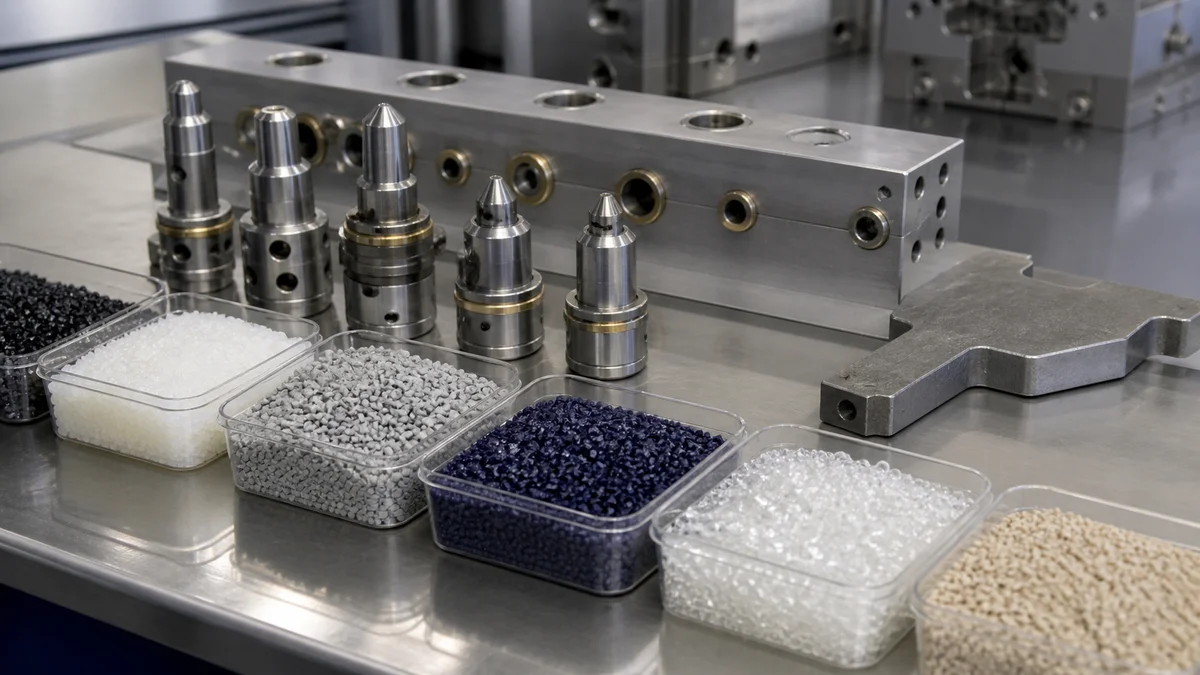
A broad material name is not enough for runner selection. Grades within the same resin family may differ in reinforcement, color package, flow behavior, and processing limits. The molder should assess the selected grade against the proposed manifold, nozzle, gate, residence-time, and changeover strategy.
Use these questions during DFM review:
- Can the resin remain in heated passages without unacceptable degradation or cosmetic change?
- Does the resin supplier define thermal-history or residence-time limits3 relevant to the proposed runner?
- Could fillers, additives, or colorants alter flow or increase sensitivity to retained material?
- May the solid cold runner be reground, and what content, segregation, or traceability rules apply?
- How often will the mold change between resin grades or colors?
- Is runner mass large enough relative to part mass to make material utilization a major cost driver?
A cold runner may fit a heat-sensitive resin, short production batches, or a program with frequent material changes. Its solid runner is not automatically acceptable regrind. Cosmetic, mechanical, traceability, or regulatory requirements may restrict reuse, and the RFQ should state those restrictions rather than leaving the molder to infer them.
A hot runner may suit an expensive engineering resin when eliminating a solid runner materially improves utilization. That benefit remains conditional on stable temperature control and an appropriate residence-time plan.
Specification mistake: Calling out only “engineering plastic” forces assumptions about grade, filler, color, thermal limits, and regrind. Specify the exact grade or list controlled alternatives that the supplier may evaluate.
How Should Gate Location and Cavity Geometry Affect the Choice?
Select the runner and gate arrangement from the part’s flow paths, wall transitions, cosmetic zones, cavity count, and permitted gate witness. Hot runners can feed cavities through heated drops, while cold runners require solid feed channels and a defined separation method after molding.
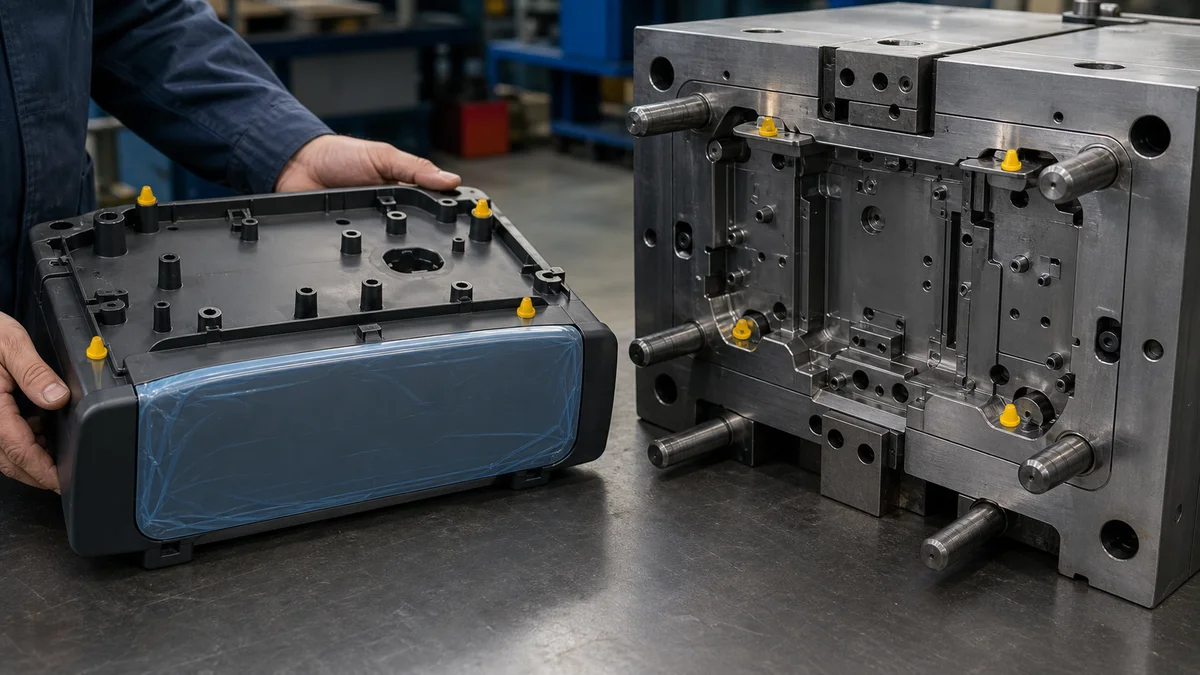
Gate position affects how resin reaches thin walls, ribs, bosses, and distant features. It also determines where the gate witness appears and whether runner separation can damage a cosmetic or functional surface. Runner selection and cavity layout should therefore be reviewed together.
| Part or mold feature | Hot-runner design question | Cold-runner design question | Required specification input |
|---|---|---|---|
| Visible exterior face | Can a heated drop avoid or control the visible vestige? | Can the gate and separation point stay outside the cosmetic zone? | Cosmetic-face map and gate-witness limit |
| Identical cavities | Are distribution and temperature consistent across drops? | Is the solid runner geometrically balanced? | Cavity count and critical consistency requirements |
| Family-mold cavities4 | Can different part weights and flow paths share the manifold? | Can dissimilar branches fill and cool under one cycle? | Each SKU’s geometry, mass, and demand ratio |
| Thin or distant features | Does the proposed gate support the required flow path? | How does the complete runner path affect filling and cooling? | Wall-thickness map and fill-sensitive regions |
| Sealing or assembly edge | Can the gate be moved or its witness controlled? | Can degating avoid cutting or deforming the edge? | Functional datums and protected-edge callouts |
Mark prohibited and preferred gate areas, visible surfaces, sealing interfaces, assembly edges, wall transitions, and fill-sensitive regions on the drawing. Include complete wall-thickness geometry5; an overall part envelope does not reveal the actual flow path.
Scenario: Consider a visible housing with a protected front face and several rear bosses. A hot runner may feed the rear geometry directly if its drops can be balanced and serviced. A cold runner may remain suitable when a concealed edge provides a practical gate and separation will not mark an assembly interface. The geometry and cosmetic map—not the label “housing”—decide the fit.
How Do Runner Systems Affect Tolerance and Inspection Planning?
Neither runner system guarantees molded-part tolerance. Acceptance still depends on resin shrinkage, packing, cooling, gate location, cavity balance, and measurement condition. Inspection should target functional features and runner-specific risks, including consistency across hot-runner drops or cold-runner degating effects.
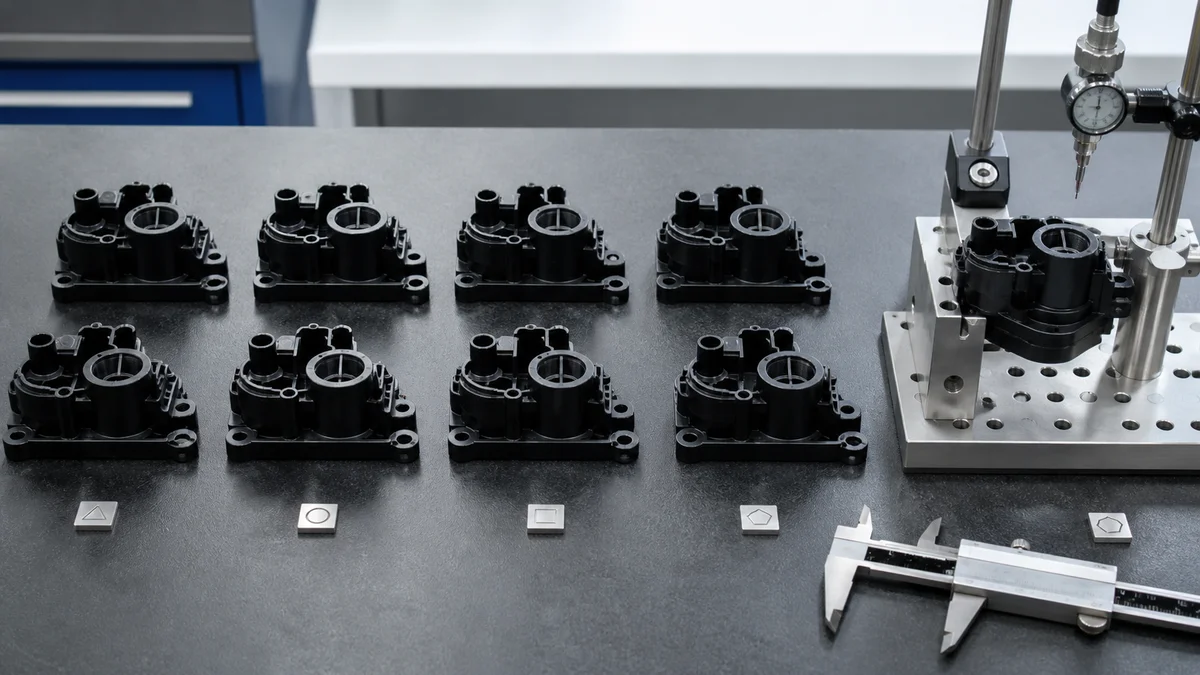
A precisely machined mold does not make the plastic part immune to molding variation. After the resin enters the cavity, shrinkage, packing, flow direction, cooling, and local wall thickness influence the finished dimensions. Tight controls should be assigned to functional features instead of applied uniformly across the drawing.
Build the inspection plan around the characteristics that govern acceptance:
- Establish functional datums and identify the bores, sealing areas, mating features, snaps, alignment points, or hole patterns related to them.
- State the measurement condition, including stabilization or material conditioning when relevant.
- Define the initial sample approval evidence required before production release.
- For multi-cavity tooling, state whether measurements must be traceable to individual cavities6.
- Specify production sampling and ongoing reports only where the acceptance plan requires them.
- Keep cosmetic criteria separate from dimensional limits, particularly at gates and degated surfaces.
For a hot runner, sample review should check whether cavities supplied by different drops produce consistent functional dimensions and appearance. The buyer should define the required output and evidence rather than prescribing unsupported machine settings. For a cold runner, inspection must cover any controlled edge or surface that can be marked, distorted, or cut during runner separation.
Specification mistake: Approving the tool from cavity-machining accuracy alone assumes the molded resin will reproduce the steel without shrinkage or process variation. Define finished-part tolerances7, datums, measurement conditions, and the inspection method or reporting outcome. When a gate sits beside a sealing edge, make gate witness and post-degating condition explicit acceptance characteristics.
Which System Has the Better Total Program Cost and Lead Time?
Compare total program cost rather than initial mold price or nominal piece price. Hot runners add heated hardware, controls, integration, validation, and service needs; cold runners can add resin use, runner cooling, separation, handling, regrind processing, and disposal throughout production.
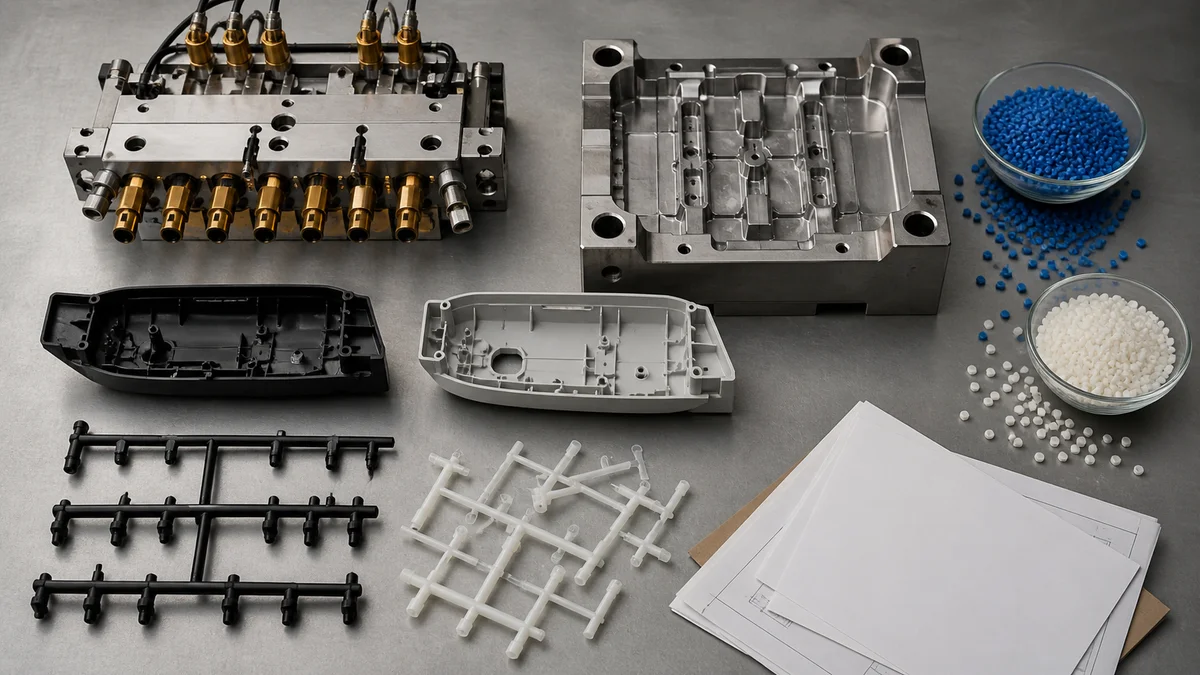
There is no universal production quantity8 at which a hot runner becomes the better investment. The result changes with cavity count, runner mass, resin cost, batch pattern, regrind permission, design maturity, maintenance assumptions, and avoided secondary work. Lead time includes tool design, construction, integration, sampling, adjustment, and approval—not only mold manufacture.
| Cost or schedule driver | Hot-runner quotation should state | Cold-runner quotation should state |
|---|---|---|
| Tooling scope | Manifold, drops, heaters, controls, integration, and validation | Runner layout, gating, separation provisions, and validation |
| Material model | Material reaching the parts, purge assumptions, and startup handling | Part mass, runner mass, permitted regrind, and discarded material |
| Cooling assumption | Part cooling and the heated-feed strategy | Cooling of both parts and solid runner before ejection |
| Secondary operations | Remaining gate treatment and inspection | Degating, sorting, grinding, handling, and disposal |
| Maintenance | Service access, monitoring, and replacement-component scope | Gate wear, runner separation, and handling provisions |
| Demand model | Immediate quantity, batch size, annual demand, and quantity tiers | The same quantities and forecast basis |
Scenario: For a stable multi-cavity part made from an expensive resin with no permitted regrind, a hot runner may reduce recurring material exposure enough to justify added tooling and service scope. If that design is still changing, runs in short batches, and rotates through several colors, a cold runner may reduce tooling exposure and simplify changeovers. This is a teaching comparison, not a fixed break-even rule.
Ask suppliers to separate their assumptions. Quotations are not comparable when one includes sample validation, replacement components, and secondary labor while another excludes them. A complete program-cost comparison9 should also identify revision risk and delivery expectations.
Which Runner System Better Handles Revisions and Changeovers?
Cold runners may better accommodate prototypes, bridge production, uncertain forecasts, and frequent resin or color changes because the feed system is simpler to clear and modify. Hot runners become more compelling when the design, material, color, and repeat-production plan are sufficiently stable.

Tooling commitment should match design maturity. A hot-runner layout ties specialized components to the cavity and gate arrangement. If part geometry, gate position, cavity count, or resin changes after release, the revision may affect the manifold or drops as well as the cavity steel. A cold runner still requires tooling changes, but its feed path is generally less complex.
Changeovers deserve separate review. Heated manifolds and nozzles retain resin, so switching color or material requires a defined purge and cleaning strategy10. The concern is not only downtime between batches: retained material can affect appearance or material condition when consecutive production runs use different specifications. A cold runner ejects its feed network, which may simplify clearing, although the molding machine and remaining passages still need suitable changeover control.
When does flexibility outweigh runner savings?
Flexibility may govern when the program has prototype or bridge quantities, unresolved gate or cosmetic requirements, several resin or color variants, short irregular batches, uncertain annual demand, or likely revisions after sample approval.
Stable repeat production can shift the decision toward a hot runner when material utilization and reduced runner handling matter. Stability means more than releasing a drawing. Confirm the resin grade, additives, color, gate arrangement, cavity strategy, production forecast, and acceptance plan.
Example: A launch needs three colors while fit, texture, and gate witness remain under review. Selecting a hot runner solely from projected lifetime demand could expose the project to difficult changeovers and expensive tooling revisions. In that situation, quote the launch phase and mature production phase separately rather than forcing both into one tooling assumption.
Which Failure Risks Must the Mold Design Control?
Hot-runner reviews must control heating, zoning, nozzle, manifold, retained-material, and service risks. Cold-runner reviews must control runner mass, separation, gate damage, material handling, and regrind disposition. Select the system whose dominant risks can be monitored, maintained, documented, and accepted.
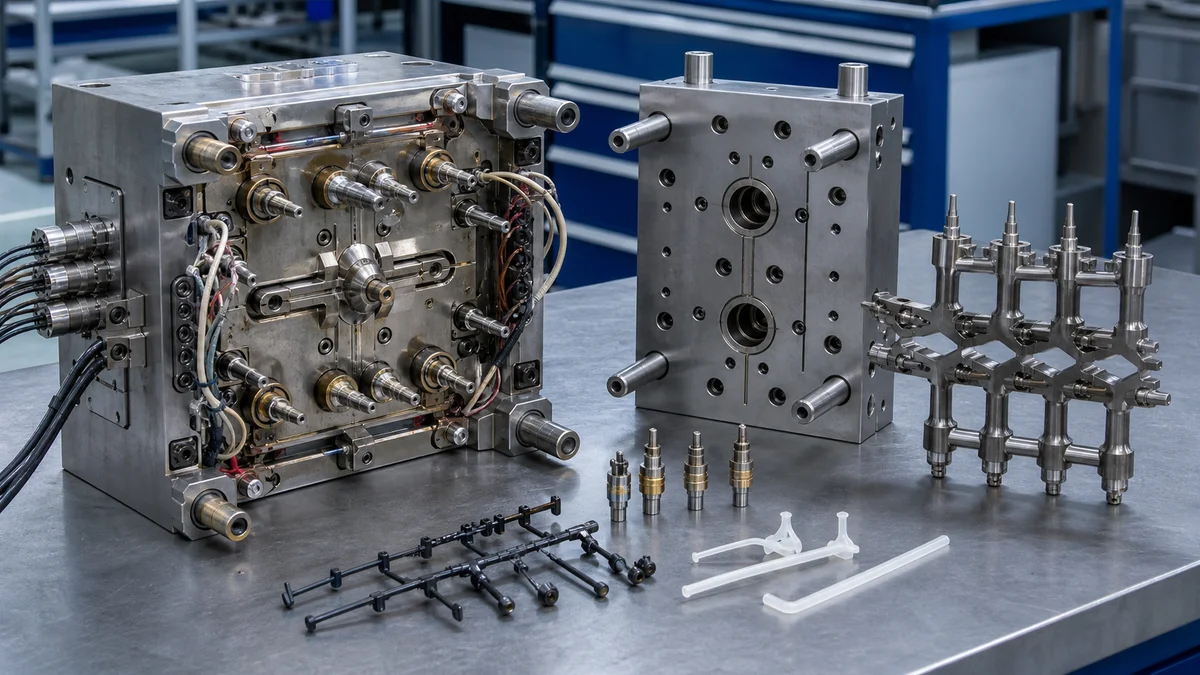
The two systems fail in different ways. A hot runner depends on a controlled thermal path11. A problem with a heater, sensor, nozzle, temperature zone, or manifold can interrupt production or produce inconsistent material conditions. Its design review should explain monitoring, access, service, shutdown, restart, and recovery after maintenance.
A cold runner avoids the heated manifold but creates a physical runner during every cycle. An unsuitable layout can add unnecessary material and cooling demand. Poor separation can leave an unacceptable gate witness or damage a nearby sealing or assembly edge. The runner also needs a documented destination: reuse, segregation, grinding, or disposal.
| Failure risk | Design or approval question | Evidence to define before release |
|---|---|---|
| Uneven hot-runner temperature | How are individual zones monitored? | Sample results showing consistent fill and accepted parts across drops |
| Retained or degraded resin | How are residence time, shutdown, restart, purge, and changeover addressed? | Resin-specific operating and material-control plan |
| Heater or nozzle service | Can critical components be accessed and replaced? | Maintenance scope and replacement-component responsibility |
| Excessive cold-runner mass | What runner mass accompanies each shot? | Quoted material model and regrind disposition |
| Gate or degating damage | Where and how is separation performed? | Gate-witness criterion12 and protected-edge inspection |
| Unapproved regrind | Does the part specification permit reuse? | Defined content, segregation, identity, and traceability rules |
A frequent mistake is treating every cold runner as recoverable material before confirming that regrind is permitted. Another is specifying a hot runner without assigning support for its temperature-control hardware and service components. Both omissions should be resolved during mold approval, before they become production interruptions or acceptance disputes.
What Should a Hot Runner or Cold Runner RFQ Include?
A runner-system RFQ should define the part, resin, demand, geometry, gates, tolerances, cosmetics, inspection, changeovers, regrind policy, sample approval, tooling ownership, and delivery expectations. Ask suppliers to compare hot and cold runner options using the same scope and stated assumptions.
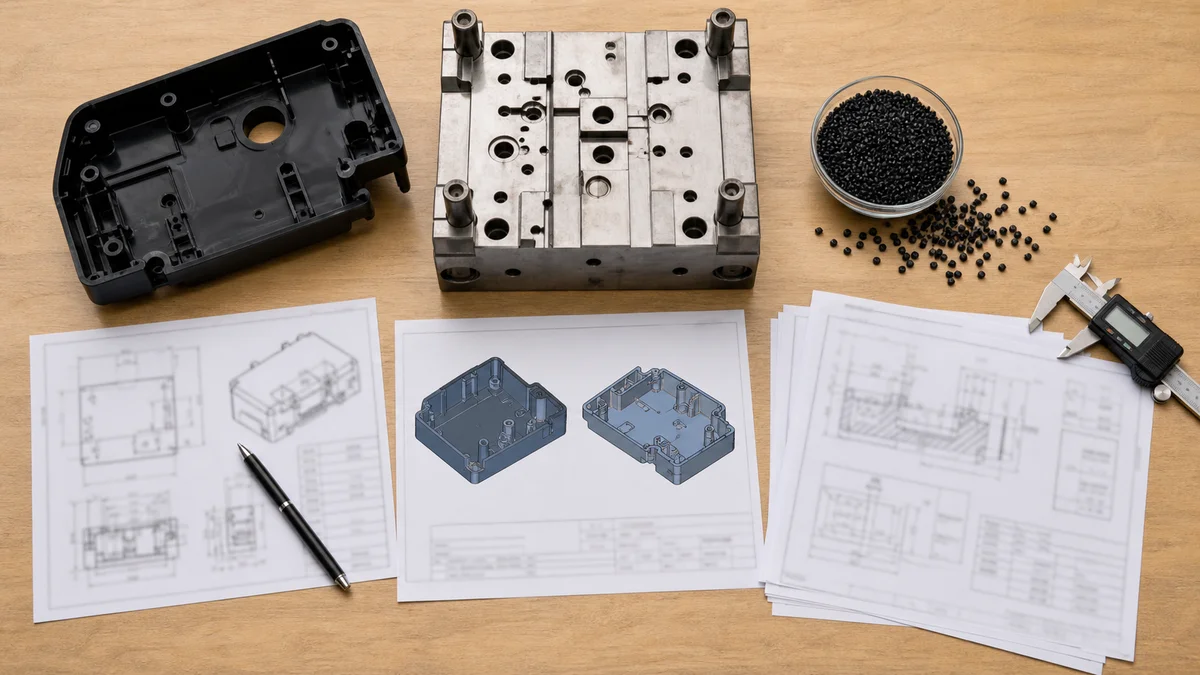
A useful RFQ gives the molder enough information to assess technical feasibility and complete program economics. When the model, drawing, material specification, or forecast is incomplete, suppliers may make different assumptions and return quotations that cannot be compared fairly.
Runner-system RFQ and approval checklist13
- 3D model: Include complete cavity geometry, nominal wall thickness, ribs, bosses, draft, and hidden features.
- Controlled 2D drawing: Show the active revision and state which document governs if the model and drawing conflict.
- Resin specification: Name the exact grade, color, additives, approved alternatives, and relevant thermal-history restrictions.
- Production demand: Provide immediate quantity, batch size, annual demand, lifetime expectation, and prototype or production intent.
- Critical characteristics: Localize tolerances, functional datums, mating features, sealing areas, and measurement conditions.
- Surface acceptance: Mark cosmetic zones, texture or finish requirements, prohibited gate locations, and the permitted gate witness.
- Cavity strategy: State the proposed cavity count and whether a family mold is being considered.
- Runner assumptions: Request runner mass, gate strategy, degating method, cooling assumptions, and material utilization for each option.
- Regrind policy: State whether runner material may be reused and list any cosmetic, mechanical, traceability, or regulatory restriction.
- Changeovers: Identify expected resin and color variants, production sequence, and changeover frequency.
- Inspection and approval: Define initial samples, critical-feature reports, cavity traceability, cosmetic approval, measurement method14, and production sampling.
- Tooling responsibilities: Clarify ownership, controls, maintenance scope, service access, and responsibility for replacement components.
- Delivery plan: State sample, validation, production, and delivery expectations without assuming an unsupported fastest lead time.
Require each quotation to separate tooling, validation, recurring production, material, secondary handling, inspection, maintenance, and exclusions. Suppliers can then compare both runner systems against one controlled specification rather than different hidden assumptions.
For a runner-system recommendation or quotation, send the 3D model, controlled 2D drawing, exact resin grade, quantity, prototype or production intent, critical tolerances, surface finish and cosmetic requirements, inspection expectations, revision level, gate restrictions, regrind policy, and delivery plan.
References
-
Injection Molding: Definition, Types & Processing Techniques - In a cold runner, the molten plastic is injected into the injection molding cavity using unheated runners. Advantages: It is easier to clean ... ↩
-
CNC and Turret Punch Press Machine and Services - A sheet of metal is sandwiched between two turrets that hold corresponding punches and dies. · The CNC punching machine can hold multiple tools, meaning costs ... ↩
-
Residence Time and Residence-Time Distribution—Part 1 ... - Failing to calculate and accurately account for residence time can compromise material integrity before it's even injected. ↩
-
Filling-Balance-Oriented Parameters for Multi-Cavity Molds ... - by HH Tsai · 2022 · Cited by 19 — Using Moldex3D and the Taguchi method, this study reveals an approach to eliminate imbalanced filling of multi-cavity molds for PVC injection molding. The ... ↩
-
Injection Molding Wall Thickness Guidelines - Walls in any plastic-molded part should be no less than 40 to 60 percent that of adjacent walls, Different resins have recommended wall ranges and flow ... ↩
-
Dimensional Inspection Guide for Molded Parts in Injection ... - Learn the best practices for ensuring dimensional accuracy in plastic injection molding to maintain quality and reduce the rate of part ... ↩
-
The Ultimate Guide to Injection Molding Tolerances - Dimensional: Overall sizing of the part. Increased part size results in larger shrinkage during cooling. This is why injection molding tolerances are listed for ... ↩
-
Hot Runner Molds for Injection Molding: Cost, ROI, Design ... - 7.2 Break-Even Volume Logic. Break-even is reached when recurring savings exceed the additional hot runner investment. The ROI pivot point depends on resin cost ... ↩
-
Hot Runner vs Cold Runner Injection Molding Comparison ... - Compare hot runner vs cold runner systems in injection molding. Learn key differences in material waste cost and applications to choose the ... ↩
-
How to Reduce Color Change Time in Injection Molding - Manifold design affects color change in any hot runner, regardless of nozzle or gating style. · Reducing melt channel diameter accelerates color ... ↩
-
Hot Runner Controller Troubleshooting Guide - This hot runner controller troubleshooting guide is to help you define the problem soonest when a mold running improperly due to temperature. ↩
-
Solving Gating Problems in Injection Molding - In injection molding, each cavity in a mold must contain a small opening called a gate, which allows hot plastic to enter the cavity before passing through ↩
-
Injection Molding RFQ Checklist for Accurate Quotes - HingTung - The quotation should identify the proposed cavity count, mold steel, runner system, tool life, resin grade, cycle estimate, inspection scope, ... ↩
-
Injection Molding FAI Report Guide: Required Fields ... - An injection molding FAI report verifies that initial molded samples match the released drawing, material callout, and defined inspection requirements, ↩